





Introduction
Gold prices doesn’t move randomly, instead they tend to be shaped by a combination of several factors such as: economic forces, investor behavior, and global uncertainty. While many people think of gold simply as “aka: safe haven” the reality is more detailed and complex. At the core, gold follows the basic principle of “supply and demand”, but unlike commodities such as oil, demand plays a much larger role than supply in driving price movements.
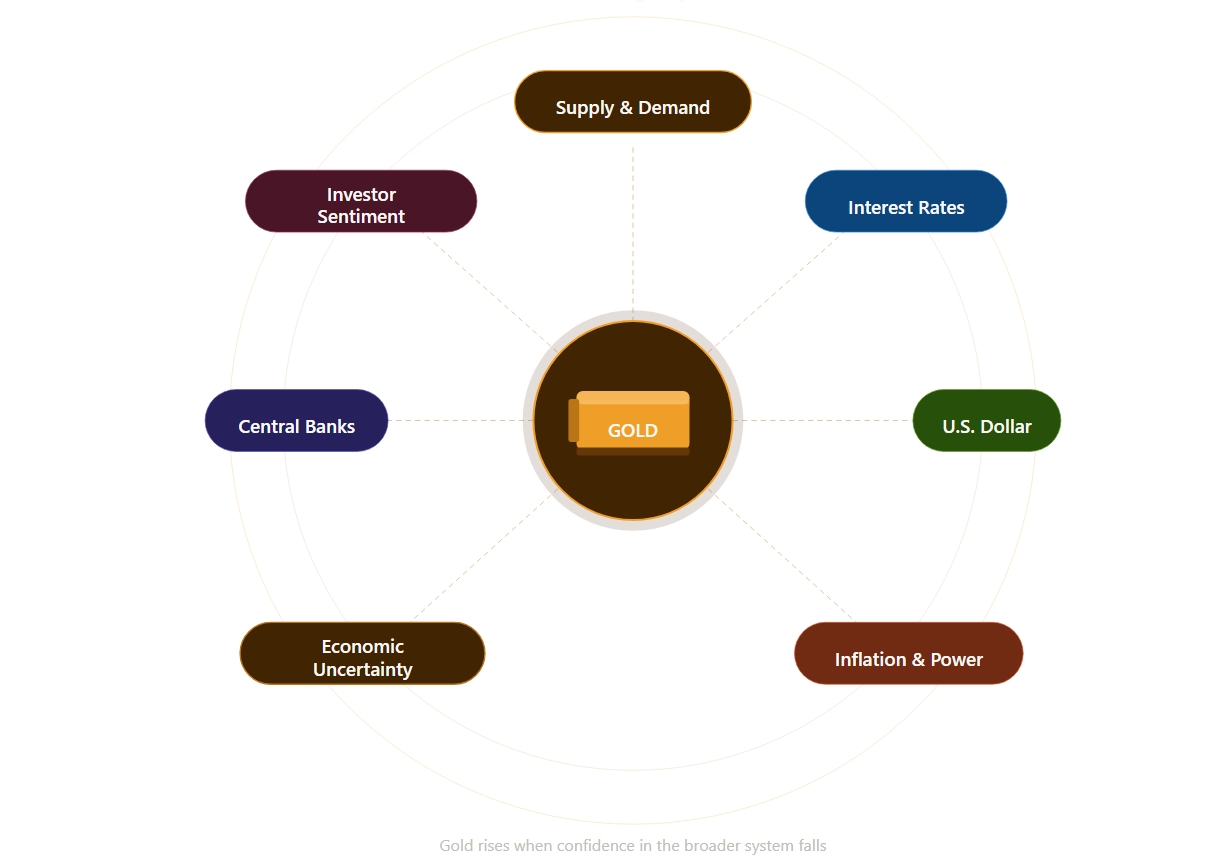 Gold rises when confidence in the broader system falls
 The factors drive gold price
Supply and Demand
Like any kind of asset, gold prices are usually influenced by how much is available versus how much people want to buy, which is the supply ( willing to supply and sell ) and the demand ( willing to demand that price to buy).
On the supply side, gold production is likely to be stable. Mining output doesn’t change quickly because it takes time and capital to increase production. This means supply tends to be predictable.
But, on the demand side, however, things are more dynamic. Demand comes from several sources:
- Investors buying gold as a store of value
- Central banks increasing reserves
- Jewelry demand
- Industrial uses
Interest Rates
Going into economic factors, interest rates have an important influence on gold prices, gold does not generate income like bonds or dividends. So when interest rates rise, holding gold becomes less attractive compared to yield-bearing assets. This can put downward pressure on gold prices. On the other hand, when interest rates fall, the opportunity cost of holding gold decreases, making it more attractive. This often supports higher gold prices.
The U.S. Dollar
Gold is priced globally in U.S. dollars, which creates an inverse relationship between the two.
- When the U.S. dollar strengthens, gold becomes more expensive for foreign buyers, reducing demand and pushing prices lower.
- When the dollar weakens, gold becomes cheaper globally, which can increase demand and lift prices.
This relationship is one of the most closely watched dynamics in the gold market.
Inflation and Purchasing Power
On the inlfation side, gold is often viewed as a hedge against inflation, thats because when inflation rises, the purchasing power of money declines. In response, investors tend to move toward gold as a way to preserve value. This can increase demand and push prices higher. However, the relationship isn’t always perfectly linear. Gold can sometimes rise even when inflation is stable, depending on broader market conditions and investor sentiment.
Economic Uncertainty and Safe-Haven Demand
“Safe haven asset” one of gold’s most important roles.
During periods of:
- Financial market volatility
- Economic downturns
- Geopolitical tension
investors often shift toward gold to protect their capital. Its long history as a store of value makes it attractive when confidence in other assets weakens. This is why gold prices tend to rise during crises or periods of instability.
Central Bank Activity
Central banks are major players in the gold market. They hold large reserves and can influence prices through buying and selling decisions. When central banks increase gold reserves, it signals confidence in gold and reduces available supply in the market, which can support higher prices. Their actions are closely watched because they often reflect long-term strategic positioning rather than short term speculation.
Investor Sentiment and Market Behavior
Lastly, going into Investor Sentiment and Market Behavior
Beyond fundamentals, gold prices are also influenced by investor psychology. Market sentiment whether risk-on or risk-off can drive capital flows into or out of gold. For example:
- In strong equity markets, investors may move away from gold
- In uncertain environments, demand for gold typically increases
Speculative activity and trading behavior can also amplify price movements in the short term.
Final Thought
Final Thought
Gold pricing is driven by a mix of fundamentals and psychology. While supply plays a role, demand especially from investors and institutions is the dominant force. Interest rates, the U.S. dollar, inflation, and global uncertainty all feed into how gold is valued at any given time.
In simple terms, gold tends to rise when confidence in the broader system falls and that’s what makes it one of the most closely watched assets in global markets.



-1741587711.webp)
