




A quick psychological test would be to ask your co-worker how much they spent during their lunch break; chances are, their answer will be a round figure like $10 or around $20, not $12.23, even if that’s exactly what's on their receipt, Humans naturally gravitate toward simplicity, and round numbers feel more comfortable, memorable, and decisive. This tendency doesn’t just influence our shopping habits; it creates invisible support and resistance zones in financial markets, but when volatility strikes and fear grips the market, do these psychological anchors still hold, or do they crumble?
In this article, we discuss how psychological levels can affect trading decisions.
What Are Psychological Levels?
Psychological levels are price points that traders and investors use mainly because of their simplicity and ease of remembrance. Understanding these levels can enhance your ability to scan for market trends and carefully structure your trading plan. These price points are typically round numbers, and traders tend to place orders at them, for example, $100 or $150, rather than $96.67 or $168.86.
How Large Institutions Use Psychological Levels?
Large market participants use psychological levels strategically because they attract liquidity and influence trader behaviour. These round numbers often become zones where retail traders cluster stop-losses and take-profits, creating opportunities for institutions to execute large orders with minimal slippage. Algorithms scan for these clusters to trigger liquidity, while currency pairs approaching round exchange rates trigger aggressive hedging activities. Breaking a major psychological barrier, such as $4,000 in gold or 1.0000 in EUR/USD, also serves as a sentiment gauge, helping institutions confirm trend strength or weakness. Psychological levels are not just retail phenomena, but they are integral to institutional trading tactics.
Volatility and Psychological levels
When there are volatility spikes due to earnings announcements, economic data releases, or unexpected geopolitical events, the order and behaviour of these levels change drastically. During these moments, the usual rules of technical analysis do not always apply. Emotions take over, and large institutions begin to dominate price movements.
In such instances, stop losses are triggered in numbers, pushing prices above previously respected levels. Momentum kicks in, amplifying price swings rather than respecting static zones.
As a result, psychological levels do not disappear, but they shift from being firm barriers to becoming a temporary hive for price action.
Do Psychological Levels Still Matter
In volatile markets, traders continue to watch these levels closely. They serve as key reference points for assessing market sentiment and risk. Levels that hold at a point signal strong bullish or bearish pressure, while decisive breaks indicate momentum shifts.
These levels provide context, highlight liquidity zones, and guide decisions on entries, exits, and risk management even when price swings unpredictably.
Chart source: TradingView
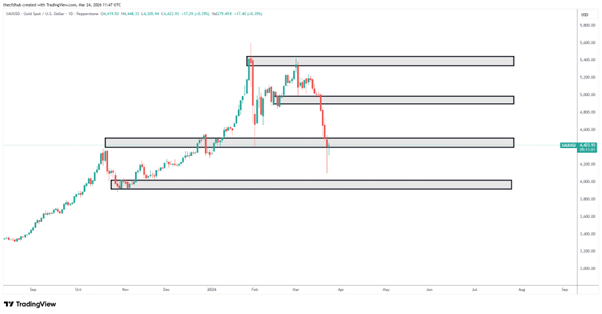
The XAU/USD chart clearly demonstrates the significant influence of psychological levels, which have defined every major turning point in gold’s historical 2025-2026 bull run.
The $4,000 zone marked the October 2025 consolidation before buyers absorbed the available supply and launched the subsequent move higher. This effectively established it as a key level for support. According to technical analysts, the $4,500 mark now plays an important role as a pivot level. It began as a level of resistance before the price broke through with conviction, effectively changing it to support. This is currently the price range at $4,426 as of March 24, 2026. The $5,000 mark has now become a major barrier. After a sharp increase in February 2026, the price was unable to sustain above $5,000 and declined. This level has now become a resistance level, preventing a price recovery in March. $5,400 remains the ultimate 'ceiling' where selling pressure is greatest.
Conclusion
Psychological levels remain important even in volatile markets; however, they function more as flexible zones than rigid barriers. Traders and investors should recognise them as guides rather than fixed guarantees; this will help traders navigate market volatility with greater confidence.
-1734333141-1792568102.webp)