



introduction
As President Donald Trump prepares for his state visit to Beijing on May 14–15, 2026, global markets have found a new way to describe the risk: the “Trump-Xi” Volatility Index. It is not listed on any exchange. It does not trade like the VIX. Rather, it reflects all the fluctuations brought about by every news item, political statement, social media comment, or diplomatic revelation connected to U.S.-China relations.
With the Nasdaq 100 just shy of 30,000, there is no longer any consideration of trade frictions between the two countries in purely geopolitical terms; rather, they have been translated into technological investments, semiconductors, electric cars, aircraft manufacturing, and capital markets.
In what has become the most recent clash, the question at hand revolves around computational sovereignty, who owns the advanced semiconductor and AI technology infrastructure that will determine the next round of economic power.
Silicon Diplomacy Replaces the Old Trade War
The new red lines between Washington and Beijing are no longer drawn around soybeans, steel, or consumer goods. They now run through the silicon inside advanced AI chips. The main flashpoint is the proposed 25% “AI Tariff” and strict volume caps on high-end processors, including Nvidia’s H200 and AMD’s MI325X.
Under Washington’s current framework, Chinese buyers would be allowed to purchase these chips only if they accept tougher compliance rules. These include Know Your Customer safeguards, site visits and controls designed to prevent sensitive AI model weights from leaking into restricted networks.
For U.S. officials, these measures are meant to protect national security and slow the transfer of advanced AI capabilities. For Beijing, they look like an intrusion into sovereign decision-making and a direct challenge to China’s technology ambitions.
That tension has turned the summit into more than a trade negotiation. It is now a test of how far each side is willing to go in controlling the future of AI infrastructure.
CEO Delegation Shows Where the Pressure Points Are
The U.S. business delegation also gives investors a clear view of which sectors are most exposed.
Among the big names that Trump has invited are Tesla CEO Elon Musk, Apple CEO Tim Cook, BlackRock CEO Larry Fink, and Kelly Ortberg from Boeing.
This is a very clear message. The talks are not just about trade tariffs. It's about supply chain dynamics, market access, semiconductor constraints, capital movements, and whether American companies will be exposed to China.
For the markets, this delegation represents a focus on four key pressure points:
Semiconductors & AI
The manufacturers of chips and other related suppliers are still right at the heart of the issue, with companies such as Nvidia, AMD, Micron, and Qualcomm being closely watched by investors
Capital markets and liquidity
Financial firms such as BlackRock, Citigroup, and Goldman Sachs are exposed to any shift in cross-border investment flows, market access, or regulatory treatment.
Consumer technology and electric vehicles
Apple and Tesla remain highly sensitive to Chinese demand, supply-chain stability, and any retaliatory measures from Beijing.
Industrials and aerospace
Boeing, GE Aerospace, and other manufacturers depend on global supply chains and long-term Chinese demand, making them vulnerable to diplomatic setbacks.
Nasdaq100 Technical Outlook according to analyst
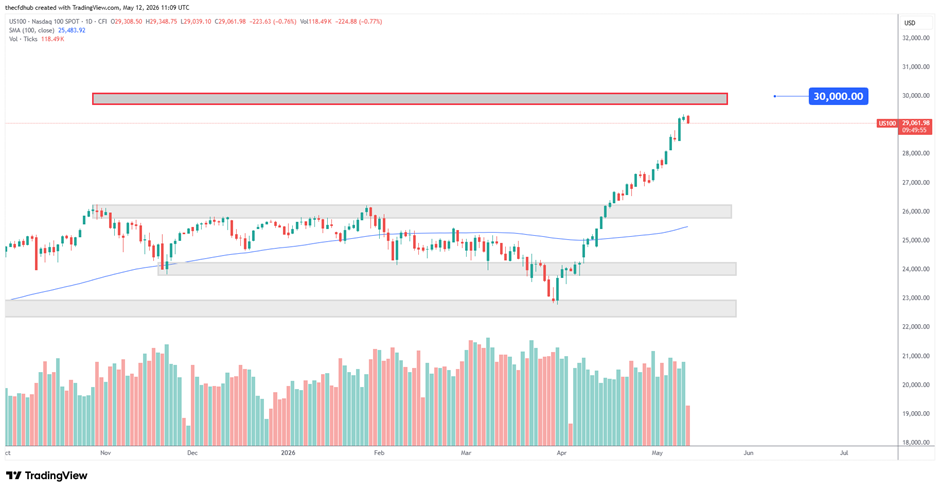
Price is currently grinding higher above its 100-day SMA (25,483), following a breakout from the mid-April consolidation base near 24,000. The index is approaching a significant supply area marked by the red zone between 29,500 and 30,000. This vertical advance, characterized by six consecutive weekly wins, has pushed the price significantly above structural support levels, increasing the risk of a "mean reversion" event if the upcoming fundamental catalysts disappoint.
Bottomline
The meeting between Trump and Xi is now an event driving sector-by-sector market volatility. As the summit approaches, markets are watching which sectors ultimately emerge with room to operate.



-Impact-on-Dollar,-Rates-&-Gold-1790852763.webp)