



Few economic releases unsettle financial markets as fast as CPI Day. Take September 2022, when a headline figure just 0.1% above forecast was followed by a 4% drop in the S&P 500 in a single session, not because "inflation remains high" was news, but because it forced a quick revision of how long the Fed would keep raising rates.
If you trade or invest around CPI, or just want to understand your portfolio's reaction, you need to read the index the way markets do.
What CPI Actually Measures
Essentially, the Consumer Price Index is an index that measures price changes of various goods and services like housing, transport, food, and healthcare in a basket. It uses data on prices in each category to produce a single number, which it releases monthly (typically the second week of each month) at 8:30 a.m. ET.
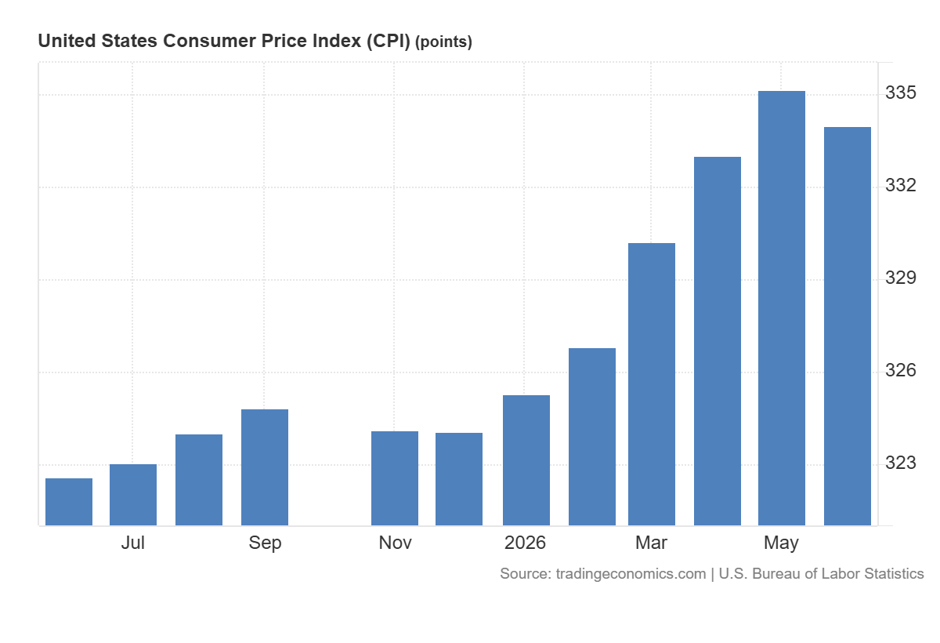 CPI (Inflation reading), Suorce: U.S. Bureau of labor Statistics
The Number Markets Actually Trade On
CPI is published as an index level (e.g., 314.5, base period = 100), but almost no one trades off the level itself. What moves markets is the surprise, the gap between the reported figure and the consensus estimate. A 3.0% year-over-year print that the market expected to be 3.0% is a non-event. A 3.0% print when 2.7% was expected can spike yields and hit rate-sensitive stocks, even though inflation is "still 3%" either way.
MoM vs. YoY: Know Which One Is Moving Markets
Month-over-Month (MoM): When seasonally adjusted, this is what traders watch in real time. It captures the most current trend and is the figure typically cited together with initial market reaction.
Year Over Year (YoY): Filters noise and gives a sense of trend over months or quarters, but it is always a lagging indicator relative to MoM.
Utilize MoM (annualized over three months) to assess momentum and YoY for validation of the inflation/deflation story.
Headline vs. Core, and Which Number the Fed Targets
Headline CPI includes food and energy, while Core CPI strips them out. Markets focus primarily on core because food and energy prices are often driven by volatile global supply shocks rather than the domestic demand conditions monetary policy actually targets. If headline is hot but core is tame, that's usually a temporary energy or food story: worth noting for consumer stocks but unlikely to shift rate expectations. If core is hot, that's the figure that moves the needle.
Crucially, while markets trade Core CPI, the Fed's official 2% target is tied to Core PCE (Personal Consumption Expenditures). CPI comes out first and directly shapes PCE forecasts, but PCE remains the Fed's ultimate benchmark for policy.
Shelter: The Category That Quietly Drives Everything
Shelter (rent and owners' equivalent rent) makes up the largest single weight in the CPI basket, often accounting for nearly a third of the index. Official shelter data also lags real-time market rents by several months due to how lease surveys are conducted. This is why many investors track private rent indices to anticipate where official shelter CPI is headed months in advance.
Seasonal Adjustment and Revisions
Always look at seasonally adjusted (SA) figures when comparing figures from one month to another since unadjusted figures may distort the actual trend because of the usual seasonal fluctuations. Note that the weights of the basket and seasonal factors are periodically updated by the BLS.
A quick framework for CPI Day:
Focus on the surprise: Judge the release against consensus expectations, not just last month's print.
Prioritize Core over Headline: It is the more policy-relevant number.
Look at MoM momentum: Catch directional shifts before they show up in YoY stats.
Isolate shelter: A hot print driven purely by shelter tells a different economic story than one driven by broad goods and services.
Conclusion
The CPI is just one data point among many, and no one good or bad print on its own alters the fundamental trend line. The art of the game is not in anticipating the number, but in interpreting it within the context of what is expected and its causes.



-Impact-on-Dollar,-Rates-&-Gold-1790852763.webp)