





introduction
Wall Street has entered a new phase of the artificial intelligence trade. For the past two years, hyperscalers could announce bigger capital expenditure budgets and watch their stock prices climb in response. That era appears to be ending. As Q2 2026 earnings season builds toward its biggest test in late July, investors are no longer asking how much the largest technology companies are spending on AI infrastructure; they're asking what they're getting back for it. And this week, that question got an unexpected macro backdrop: Federal Reserve Chairman Kevin Warsh's first congressional testimony.
The Number Everyone Is Watching
Alphabet, Microsoft, Meta, and Amazon have together spent over $220 billion on capital expenditure for artificial intelligence in the last four quarters. Guidance for 2026 capex spending for the quartet of hyperscalers can get as high as $725 billion. The key measure being discussed on analyst calls is the AI capex/revenue ratio and whether this expenditure is manifesting itself as cloud revenue growth or as an increase in depreciation expense. Growth numbers for Azure, AWS, and Google Cloud will be scrutinized line by line, and anything signaling spending ahead of demand will be harshly penalized.
The Calendar
Alphabet reports July 22
Microsoft and Meta report July 29
Apple and Amazon follow July 30
Nvidia doesn't report until late August
Nearly the entire AI-infrastructure complex, minus Nvidia, will report within nine days, with Nvidia's later report serving as either a confirmation or a reckoning depending on how the rest of the month goes.
On Tuesday 14 July, Warsh delivered his first semi-annual monetary policy testimony to the House Financial Services Committee, just hours after data showed June inflation cooled to 3.5% annually from 4.2% in May. Warsh made clear the Fed isn't declaring victory: he said the Committee has no tolerance for persistently elevated inflation and remains resolutely committed to restoring price stability. Rates stayed at 3.5%–3.75% at June's meeting, and markets currently price an 86% probability of a hold at the next one. More striking for the earnings story: Warsh himself pointed to the AI capex boom as a macroeconomic force, calling the current pace of business investment the most notable feature of the economy and attributing it largely to data center construction and demand for AI-related equipment. That's a Fed chair effectively confirming, from national accounts, the same spending wave now under the market's microscope.
Why This Matters for Positioning
Hyperscaler valuations aren't judged on capex-to-revenue ratios alone; they also hinge on the discount rate investors apply to future cash flows. A Fed that stays cautious on inflation despite a cooler print keeps rates higher for longer, raising the bar for how much cloud growth is needed to justify today's valuations. A steady-rate backdrop, which is what markets currently expect, gives Alphabet, Microsoft, Meta, and Amazon a bit more room to be judged on their own numbers rather than through a tightening lens. The two storylines are now intertwined. The first three weeks of July set the macro tone: inflation data, Fed testimony, rate expectations. The real test starts July 22 and compresses into nine days through July 30. Whether hyperscalers can show that a $725 billion spending program is paying for itself will do more to shape the broader market's trajectory than anything else in this earnings season, and it will play out against a monetary backdrop that, for now, isn't standing in the way.
NAS100: The Analysts' Technical Take
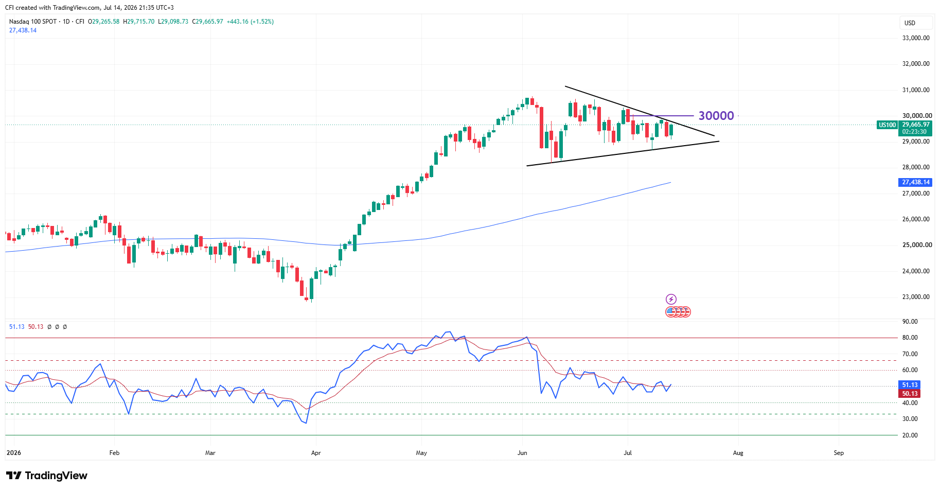 Nasdaq 100, Time frame: 1D, Source: Tradingview
The Nasdaq 100 continues to trade in range following its rally from about 25,000 in April to the high of 30,700 in early June. Over the last six weeks, trading activity has been confined to a symmetrical triangle formation below the 30,000 mark, indicating a contraction in volatility and a balance between bulls and bears. CFI Custom RSI (14-period RSI with 9 Period EMA) is trading near the 50 level, indicating neutrality.
-1791281116.webp)


-1790847824.webp)