





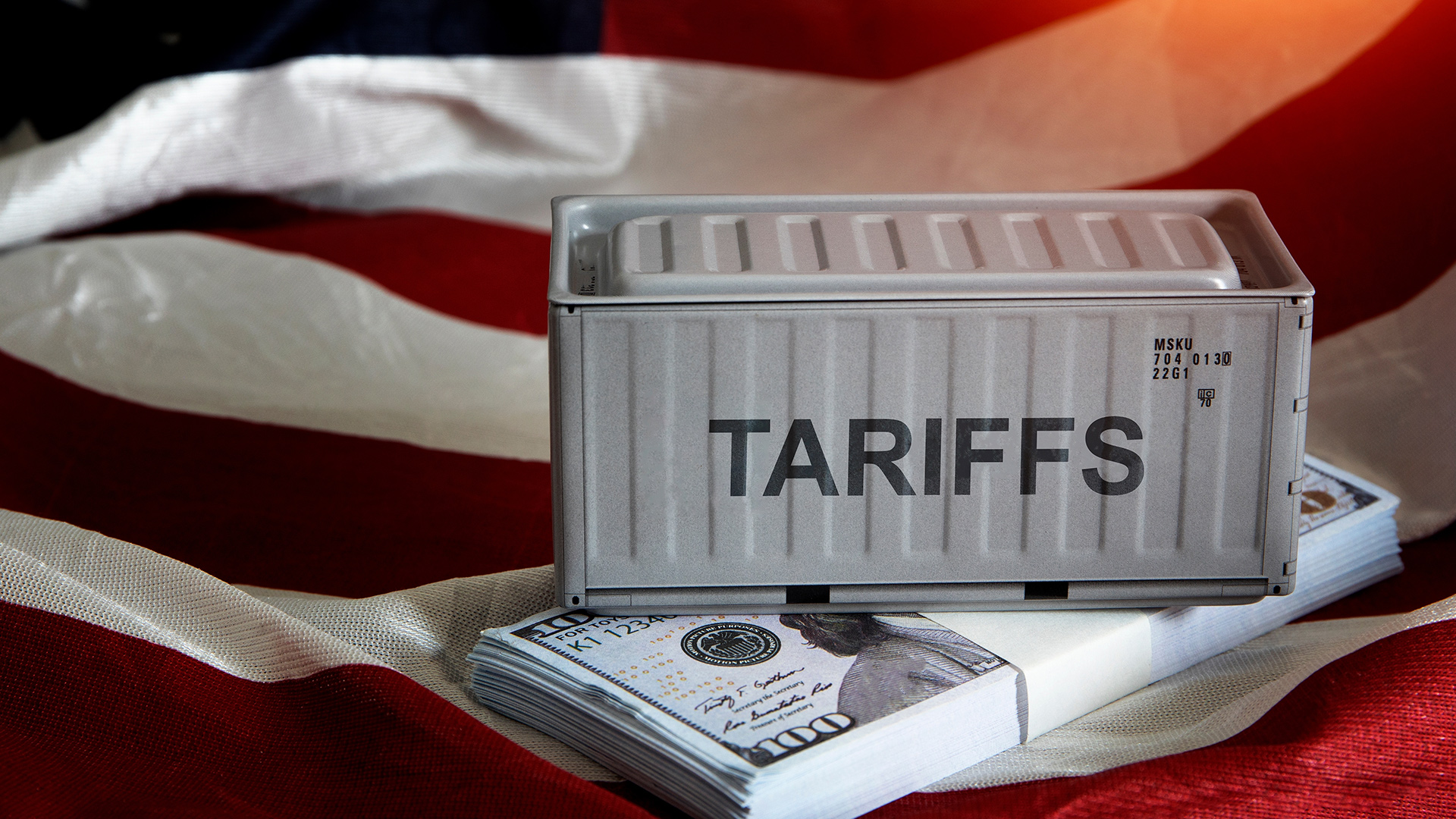
This week, everyone in the markets is watching for the US Supreme Court's decision to pause Trump’s latest tariff decisions, all the while geopolitical tensions continue and the earnings of the world’s largest company are scheduled on February 25th.
Meanwhile, US economic data remains under scrutiny as investors try to time the Fed’s next interest rate cut, given the slight improvement in inflation indicators as well as the drag on last year’s fourth-quarter growth data due to the country’s longest government shutdown ever.
Key takeaways:
- Markets assess the elimination of US tariffs
- Nvidia earning results dominate the scene
- Significant economic data set for this week
Impact of Tariff Elimination on Global Financial Markets
1. The US economy: The impact of tariff elimination & Nvidia's earnings
Investors will be monitoring the consequences of the US Supreme Court ruling out the president's April decision on trade tariffs, amidst ongoing geopolitical tensions in key regions.
This week, investors will also witness the earnings release of the world’s largest company by market capitalization, the tech giant Nvidia, following the close of the market on Wednesday.
Some key economic data will also be monitored as investors try to gauge the next interest rate cut, given the slight pullback in inflation and the impact of the largest government shutdown on the country’s Q4 growth results.
Further inflation-related indicators are set to be released this week, with January’s Producers Price Index (PPI) set to be out on Friday, which is forecasted to slow slightly on the annual front, alongside the Consumer Confidence Index, which is expected to improve modestly.
The impact of the US tariff elimination ruling
The US Supreme Court ruled out President Trump’s tariffs that he imposed after returning to office last year. Said tariffs ignited widespread concerns across many economic sectors in the country and beyond, especially regarding the US’ relations with economic allies.
The imposition of tariffs last year had a very turbulent effect on financial markets, which saw a noticeable decline accompanied by a drop in the value of the US dollar, pushing many institutions to move away from USD-denominated assets.
On the other hand, safe assets like gold and silver went up after the US imposed tariffs, as they created an economic climate of uncertainty.
After the US Supreme Court eliminated tariffs, investors will be awaiting the response of the US administration, which lately signaled its intentions to impose new tariffs if the old ones were ruled out, thus raising the prospect of renewed uncertainty. This is especially relevant given that Trump has already imposed new tariffs of 15% for 150 days under Section 122, though their effective start date has yet to be determined.
Nvidia's earnings under the spotlight
Nvidia’s 2026 Q4 earnings results will be reported this Wednesday. Expectations point to revenues of approximately $66 billion, representing 70% year-over-year growth.
This earnings report is expected to have a positive impact on Nvidia’s stock performance and the performance of the entire tech sector. It is worth noting that the company has consistently reported strong results, beating expectations for six consecutive quarters, which strengthens the likelihood of an even stronger performance in Q4.
Market attention will not be solely on revenue but also on the performance of data center segments as well. The massive demand for the Blackwell platform (which the company's CEO has described as robust) and its positive contribution to revenues.
Markets will also be monitoring the company’s transition from the Blackwell platform to the Rubin platform, which Nvidia expects to represent a revolutionary leap in the world of artificial intelligence.
2. The European economy: Key economic data ahead
Europe is facing a critical week ahead full of major economic data releases and consumer and corporate surveys, with a range of indicators released across many European nations, including Germany, France, and Italy.
This week is due with the Eurozone business and consumer survey, the European Central Bank's Consumer Expectations Survey, and Eurozone inflation data—with forecasts pointing to levels remaining below the 2% target range.
Additionally, investors and traders will be looking for any additional signals that the Bank of England is planning on cutting rates at its upcoming March meeting, with current expectations putting the probability at 78%.
3. The Japanese economy: Rate hike probabilities
Markets continue to await any new signals on whether the Bank of Japan intends to hike interest rates soon, with attention turning to a speech set by a Monetary Policy Board member on Thursday.
Tokyo Consumer Price Index data—the country's primary inflation indicator—is also due for release, and the figures may offer clues about the direction of monetary policy from the Bank of Japan.
4. The Chinese economy: Lunar New Year celebration
China’s financial markets are set to reopen following the extended Lunar New Year celebrations, with expectations that equity movements will catch up with the series of events, data, and indicators released during the break.
The People's Bank of China will announce benchmark interest rates linked to most personal and corporate loans, with expectations for no change—as policymakers await the right moment to deliver further support to stimulate the domestic economy. The People's Bank of China is expected to resume rate cuts in the second half of the year.
The economic calendar following the Tariff Elimination in 2026:
| Country | Economic Indicator | Previous Reading | Forecast |
| Tuesday, February 24, 2026 | |||
| US | Consumer Confidence Index | 84.5 | 86 |
| Wednesday, February 25, 2026 | |||
| US | U.S. Presidential Address | — | — |
| Japan | Consumer Price Index | 1.9% | — |
| Eurozone | Consumer Price Index | 1.7% | 1.7% |
| Thursday, February 26, 2026 | |||
| US | Initial Jobless Claims | 206K | — |
| Japan | Tokyo CPI (YoY) (February) | 1.5% | — |
| Japan | Industrial Production | -0.1% | — |
| Friday, February 27, 2026 | |||
| US | Producer Price Index | 3.0% | 2.8% |



-1786712547.webp)
-1724934015.webp)