




Keywords:
Financial markets hold up despite crises thanks to phases of shock, absorption, and adaptation.
Gold's performance defies expectations and does not reflect its traditional role as a safe haven.
Expected market scenarios as the August 1 tariffs approach.
Introduction: Financial Markets Under Pressure: Resilient Amid Crises
Despite ongoing geopolitical and trade tensions, global financial markets continue to maintain their resilience.
Some indicators have even reached historic record highs, raising serious questions among investors and traders about the reasons for this financial market resilience despite markets being under constant pressure.
This question is heightened by several factors that could increase the risks surrounding global financial markets, including: -
Continued geopolitical tensions, albeit at a slower pace than during the first half of 2025.
A return to rising inflation rates considering U.S. tariffs.
Continued trade tensions with the US and several major economies, such as the European Union, Japan, Canada, and Mexico.
The relationship between US President Donald Trump and Federal Reserve Chairman Jerome Powell has become strained over the Fed's interest rate policy, with Powell insisting on not rushing to cut interest rates, contrary to the US president's wishes.
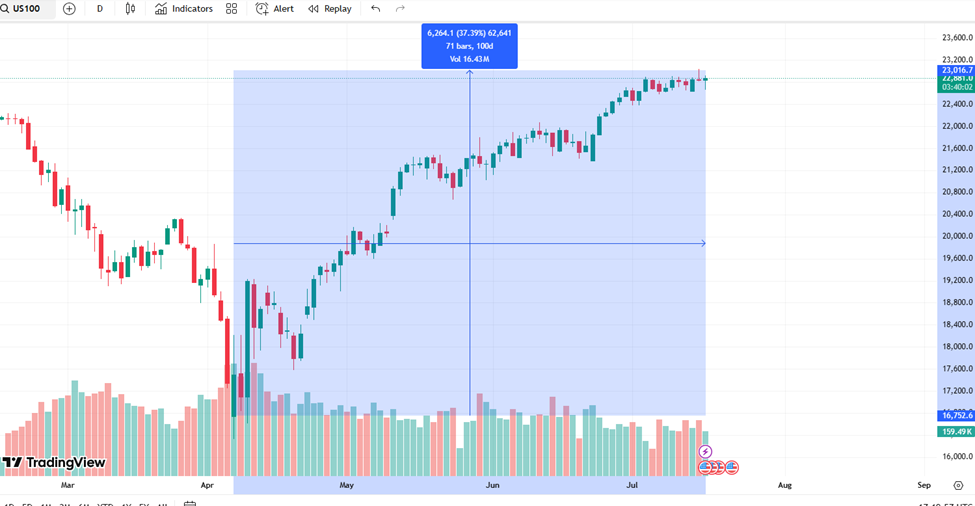
Figure (1): The performance of the Nasdaq technology index records an all-time high of 23,000.
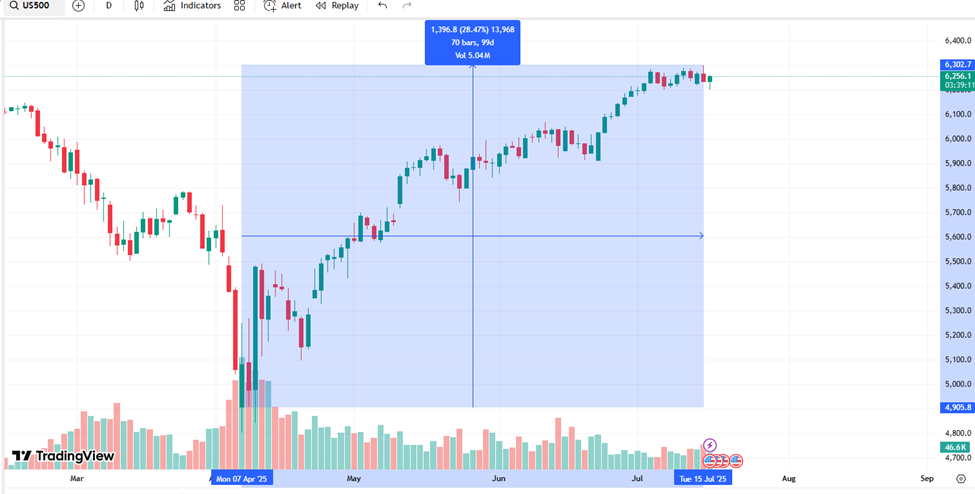
Figure (2): The performance of the S&500 which recorded its all-time high of 6,300.
Gold’s Unusual Behavior During Global Tensions!
This question even concerns gold trading, a traditional safe haven, which, despite these tensions, has not recorded the price increases it experienced between the beginning of 2025 and April of the same year. The following chart illustrates the price increase of more than 30% until April, compared to the 5.4% recorded after April and until mid-July 2025.
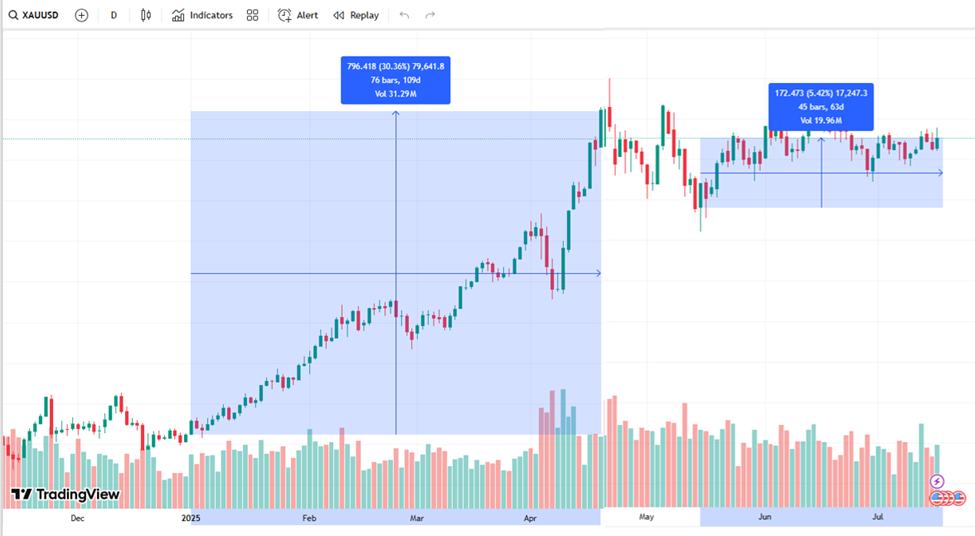
Figure (3): Gold's performance between two periods of geopolitical and economic tensions in 2025
Financial Markets Under Pressure — Yet Remain Resilient!
From the above explanation, it appears to be a strange paradox between the performance of US financial markets, which did not significantly respond to the aforementioned tensions, and the performance of gold, which was not performing normally considering the various tensions and turmoil.
The attempt to answer this question may lie in understanding the nature of financial markets themselves, which react to events in three basic stages: Shock Absorption Adaption

Initially, markets are subject to a strong shock when any major and sudden event occurs, especially if it involves both geopolitical and economic factors, as occurred at the beginning of the second quarter of 2025. Financial markets react violently, often causing sharp declines and immediate losses.
Over time, markets begin to undergo what we call market comprehension, a phase in which markets react to new developments and reassess their previous impact.
Markets then begin to gradually adapt, decreasing their response to the same events over time, even if they are sometimes dangerous in nature, because they have become part of expectations.
Markets may even shift to ignoring events if there are larger positive developments, as happened when Nvidia shares rose amid very positive news about technology and artificial intelligence between the US and China (Nvidia's resumption of H20 chip exports to China).
Is this pattern always consistent?
Recent history tells us some of the patterns financial markets may adopt when dealing with negative events and developments.
The following is an attempt to develop scenarios for what could happen to financial markets, especially considering the ongoing trade tensions regarding the tariffs and their new implementation date of August 1, with Trump confirming that this will be a deadline for all parties to conclude their agreements with the US.
Scenario 1. Continued escalation from the US side until August 1:
If the escalating rhetoric and threats of higher US tariffs continue, markets may be slow to respond and cautious. They may be inclined to wait and analyze the situation gradually before making a final decision, especially while awaiting updates on US inflation figures and the labor market.
Scenario 2. Progress in international negotiations:
This scenario would be most suitable for financial markets, which may take a more rapid upward trajectory, as this scenario reflects reassuring signs of cooperation.
Scenario 3. The conflict has become more complex:
This scenario may be the most complex for financial markets, depending on the scale of the conflict and the parties involved. This is especially true if inflation rises further or labor markets decline more deeply. This could open the door to significant declines, especially if markets perceive the situation as worsening.
Conclusion:
Financial markets are not static entities, but rather dynamic entities that react to events based on their magnitude, intensity, frequency, and concurrence with other events.
This is especially true given that the coming years will witness the first-ever results of major companies' operations under US tariffs, particularly the 10% tariffs imposed on April 2nd.