



-1748162616.webp)
Introduction:
The current issue of the ‘’economy spotlight’’ Report discusses the latest developments in the tariffs that Trump escalated after he announced he would impose high tariffs on Europe. He also attacked Apple and threatened it with tariffs if it did not manufacture its iPhones in the US.
The report also highlights several economic issues facing major economies, and China's economic resilience in the face of Trump's tariffs.
Main keywords:
Trump returns to threatening tariffs, raising fears among investors.
Apple is under threat from Trump, especially its iPhones, which are manufactured outside the US.
Important economic data is awaited by the US economy this weekend.
A rice crisis hitting the Japanese economy underscores the extent of the structural problems plaguing the Asian economy.
The Chinese economy is caught between mixed economic data and its ability to adapt.
Economy Spotlight. Major Economies:
First: US Economy: Trump threatens Europe with tariffs!
The US economy has witnessed many events and statements, amid heightened economic uncertainty after Moody's downgraded the US economy's credit rating and the passage of the tax bill in the House of Representatives.
The term "recession" was the most frequently mentioned by many analysts, coinciding with statements by one of the world's largest bank presidents.
Some Federal Reserve chairmen and members of the Open Market Committee made mixed statements after Trump returned to attacking the Fed and urging it to cut interest rates.
While Beth Hammack, President of the Cleveland Federal Reserve, warned of the difficulty of predicting the economic path, two Federal Reserve officials indicated that interest rates would not be cut before the September meeting.
Meanwhile, Chicago Fed President Austin Goolsbee said that interest rate cuts are possible over a time horizon of 10-16 months.
The term "economic recession" was one of the terms frequently mentioned last week. JPMorgan Chase Chairman Jamie Dimon pointed to the threat of tariffs to the US economy, reminiscent of the stagflation of the late 1970s.
A University of Michigan poll showed that Republican voters expect inflation to rise in the coming weeks, based on statements from major US retailers like Target and Walmart.
Trump threatens Europe with tariffs again!
Trump returned to the tariff threat last weekend, recommending a 50% tariff on the European Union on June 1 and warning Apple that it would be forced to pay tariffs if its iPhones were not manufactured in the US.
Trump's threat affects approximately $262 billion in European exports to the US market, primarily medical and pharmaceutical exports, estimated at approximately $120 billion, and automobile, aircraft, and related products, estimated at approximately $67 billion, among other important exports.
These threats specifically target three European countries, which are the largest exporters to the US market: Germany, Ireland, and Italy. France is also affected by Trump's threat to impose high tariffs on luxury goods, which are a key pillar of the French economy.
As for Apple, Trump threatened to impose a 25% tariff on phones manufactured outside the US. Experts say this is extremely difficult economically and technically, and they even suggest that this move could increase the ability of other manufacturers to compete with Apple.
Trump indicated that these tariffs could affect other factories, such as Samsung and others, and it is expected that these tariffs will be implemented by the end of June.
Contradictory statements and developments in the tariff file have revived investor concerns, at a time when markets are awaiting news of trade agreements with several parties, such as India, South Korea, Vietnam, and Japan.
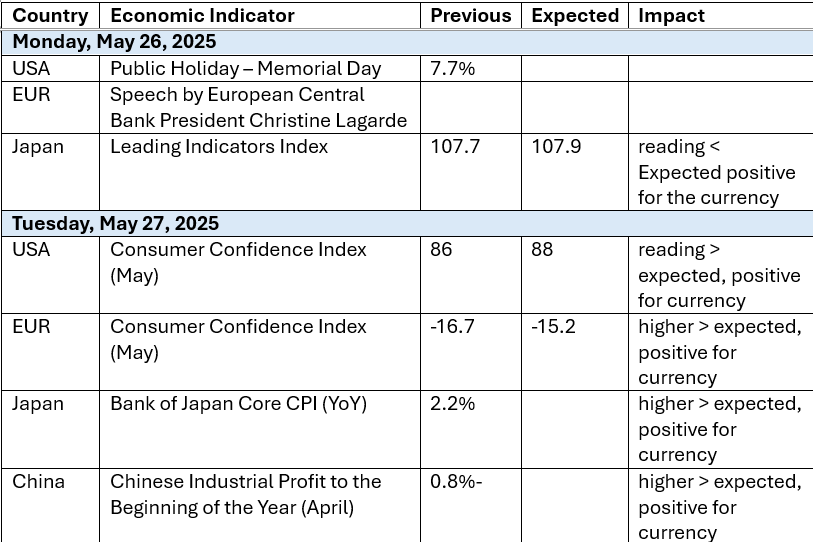
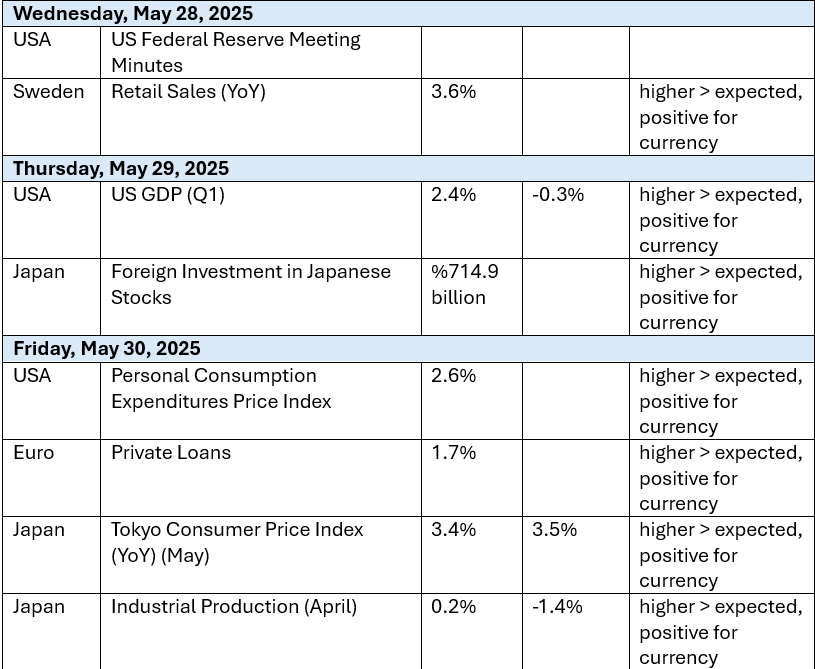
The picture is expected to become clearer in the coming days. On the economic agenda, the US economy awaits important events, most notably the revised GDP reading for the first quarter of this year, and details of what happened at the latest Federal Reserve meeting. The Fed's preferred inflation reading, the Personal Consumption Expenditures Price Index, is also awaiting release.
Second. European Economy:
The European Commission released its economic forecast for spring 2025, predicting continued slow growth due to ongoing concerns about US tariffs, low inflation, and a relatively strong labor market. The Commission forecasts that growth will continue slowly in 2025, with a possible rebound next year.
The European Commission released its economic forecast for spring 2025, showing that the European Union economy started this year stronger than expected. Growth is expected to continue slowly in 2025, with a rebound in 2026.
The most notable statement made last week was by Yannis Stournaras, Governor of the Bank of Greece, who said that the euro could gradually replace the US dollar as the global reserve currency, provided that the Old Continent unifies, which he sees as significantly undermining the continent in the face of Trump's tariffs. European markets ended last week with Trump threatening to impose high tariffs early next month, which sent many European stock indices lower. The Swiss franc rose more than 1% on Friday, and by about 2.5% on a weekly basis against the dollar, as investors sought a safe haven from volatility.
Third. Japanese Economy:
Japan's economy contracted for the first time in four quarters during the three months ending in March. Seasonally adjusted real GDP fell 0.2% in the first quarter compared to the previous three months, translating into an annual decline of 0.7%. This contraction was driven by weak private consumption and the first quarterly decline in exports in a year, indicating a slowdown in Japanese economic growth.
Japan is also facing a major crisis in the most important food commodity for Japanese citizens, as Japanese citizens have begun to notice a shortage of domestic rice and a doubling of its prices, highlighting broader weaknesses in the Japanese economy. Japan imports more than half of its food from abroad, amid rising prices. This exposes the resilience of the Japanese economy to severe tests due to supply chain pressures and rising trade tensions considering US tariffs.
All of these problems led the Bank of Japan to downgrade its outlook for the global economy amid the ongoing economic uncertainty that has been ongoing for the past year. Japan is awaiting important readings on inflation and industrial production this week, with inflation expected to rise and industrial production expected to decline sharply, the largest since the beginning of the year.
Fourth. Chinese Economy:
After China and the United States reached an interim trade agreement, markets felt some relief regarding the Chinese economy, which continues to suffer from weak domestic consumption and ongoing problems in the vital real estate sector. Despite the decline in retail sales, housing, and investment in April, some other economic data came in stronger than expected, demonstrating the resilience of the Chinese economy thanks to recent government support.
Some analysts believe that the US tariffs have encouraged China to restructure its economy to ensure relative self-reliance, particularly in the technology and financial sectors, in addition to its openness to foreign investment.
In fact, a spokesperson for the National Bureau of Statistics of China confirmed that the Chinese economy is maintaining stable growth despite the pressures, especially after the services production index rose by 6%, and the growth of the travel, tourism, transportation, and communications sectors, along with a 3.9% growth in trade with Belt and Road countries. This was interpreted as a Chinese attempt to offset the impact of the US tariffs.
Economy Spotlight. Economic Calendar and What to Expect in the Markets Next Week:
Global markets will be awaiting the following economic data: