
Key Takeaways
- A currency pair shows how much of the quote currency is needed to buy one unit of the base currency. In EUR/USD, EUR is the base currency and USD is the quote currency.
- Buying a pair means buying the base currency and selling the quote currency. Selling a pair means the opposite.
- A pair’s price rises when the base currency strengthens and falls when it weakens.
- The three main types are majors (always include USD), crosses or minors (two major currencies without USD), and exotics (a major currency paired with an emerging-market currency).
- Exotic pairs generally have wider spreads, lower liquidity and higher risk than majors.
What is a Currency Pair?
A currency pair shows the value of one currency compared to another. The first currency is called the base currency, and the second is the quote currency. It tells you how much of the quote currency is needed to buy one unit of the base currency. For instance, a currency pair like EUR/USD shows the euro’s value compared to the US dollar. In this pair, EUR is the base currency, and USD is the quote currency. It indicates how many US dollars are needed to buy one euro. Currencies are identified using three-letter codes: EUR for the euro, USD for the U.S. dollar, CAD for the Canadian dollar, and AUD for the Australian dollar.
How to read a Currency Pair?
Let’s break it down simply with an example using the EUR/USD currency pair:
If the EUR/USD exchange rate is 1.15, it means 1 euro is worth 1.15 U.S. dollars.
- Buying EUR/USD means you are buying euros and selling U.S. dollars.
- Selling EUR/USD means you are selling euros and buying U.S. dollars.
In forex trading, every trade involves two currencies at the same time, when you buy one, you automatically sell the other. This is because currencies are always traded in pairs, like EUR/USD.
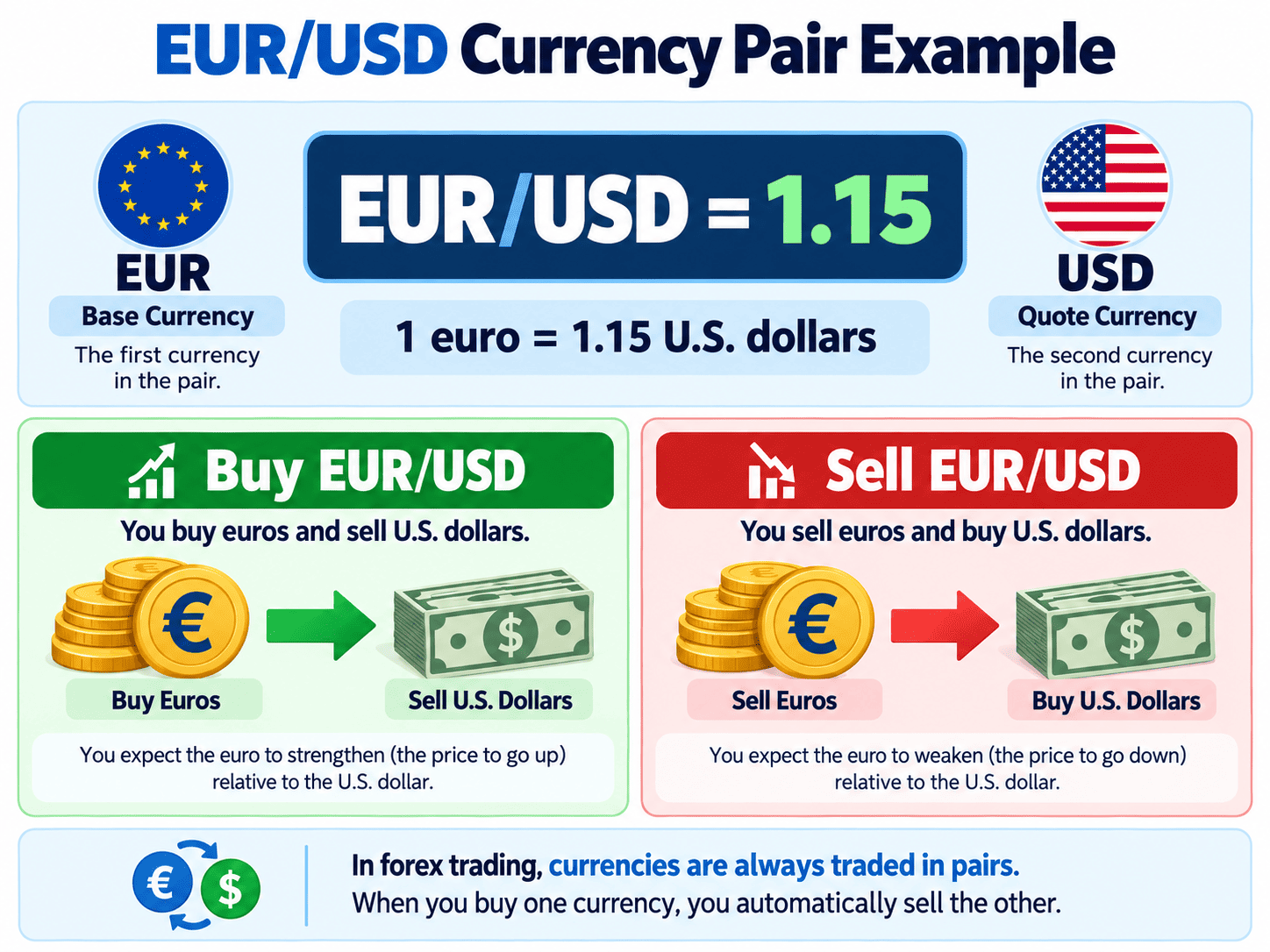 Figure 1: EUR/USD Currency Pair Example
Currency pairs are just one part of how the market works. If you’re new to FX, start with our guide to forex trading for beginners.
Base Currency vs Quote Currency
In a currency pair, the base currency is the first currency listed, while the quote currency is the second. For example, if EUR/USD is trading at 1.10000, it means 1 euro is worth 1.10 US dollars. The exchange rate shows how much of the quote currency is needed to buy one unit of the base currency.
Bid Price, Ask Price and Spread
When trading forex, you will notice two prices for every currency pair: the bid price and the ask price.
- Bid Price: The price at which you can sell a currency pair.
- Ask Price: The price at which you can buy a currency pair.
- Spread: The difference between the bid and ask prices, representing a trading cost.
For example, imagine EUR/USD has a bid price of 1.07980 and an ask price of 1.08000. The difference is 0.0002, equivalent to a 2-pip spread.
This means that when you open a trade, the market must move in your favor by 2 pips to cover the spread, assuming it remains unchanged and there are no additional trading costs.
How Do Currency Pair Prices Move?
When the Base Currency Strengthens
Using the same example of EUR/USD, let’s consider a scenario where the euro strengthens against the U.S. dollar. This could happen for instance when the European Central Bank (ECB) raises interest rates, one of the causes that could increase the value of a currency. Higher interest rates often attract more investors seeking better returns, increasing demand for the euro and making it more valuable (appreciated) compared to the dollar. As a result, one euro will be worth more dollars, causing the pair’s price to increase.
For example:
- Before the euro appreciates, the price is EUR/USD = 1.05928.
- After the euro appreciates, the price rises to EUR/USD = 1.07840.
This reflects the stronger euro being able to buy more US dollars.
When the Base Currency Weakens
On the other hand, if the euro loses value (depreciates) against the U.S. dollar, the pair’s price is likely to decline, potentially driven by weak economic data. Let’s explore a scenario where the euro weakens against the U.S. dollar. This could happen if the European Central Bank (ECB) lowers interest rates. Lower interest rates make the euro less attractive to investors seeking higher returns, reducing demand for the currency and decreasing its value compared to the dollar. As a result, one euro will be worth fewer dollars, causing the pair’s price to drop.
For example:
- Before the euro depreciates, the price is EUR/USD = 1.07840.
- After the euro depreciates, the price falls to EUR/USD = 1.05928.
This reflects the weaker euro being able to buy fewer US dollars.
If you believe the base currency will get stronger compared to the quote currency, you can buy the pair. If you think it will weaken, you can sell the pair.To understand how much the price moves, Forex traders use pips.
What is a Pip?
A pip is the standard unit used to measure price movement in a currency pair.For most currency pairs, 1 pip represents a movement in the fourth decimal place.
EUR/USD: 1.15000 → 1.15010 = 1 pip
Complete Guide to PipsWhat Does Buying or Selling a Currency Pair Mean?
When trading forex, you can potentially profit from both rising and falling currency prices by buying (going long) or selling (going short) a currency pair.
Buying a Currency Pair (Going Long)
When you buy a currency pair, you expect the base currency to strengthen against the quote currency.
For example, imagine you buy EUR/USD at 1.10000:
- If the price rises to 1.10500: You gain 50 pips.
- If the price falls to 1.09500: You lose 50 pips.
Selling a Currency Pair (Going Short)
When you sell a currency pair, you expect the base currency to weaken against the quote currency.
For example, imagine you sell EUR/USD at 1.10000:
- If the price falls to 1.09500:You gain 50 pips.
- If the price rises to 1.10500:You lose 50 pips.
In both cases, your actual profit or loss depends on your trade size, the price movement, and trading costs such as spreads and commissions.
Types of Currency Pairs
Currency pairs are categorized into three main types: Majors, Crosses, and Exotics. Let’s take a closer look at each category:
Major Currency Pairs
The major currency pairs are the most popular and widely traded in the forex market. There are 8 major currencies because these are the most widely traded and important currencies in the global economy, such as the USD, EUR, JPY, GBP, AUD, CAD, CHF, and NZD. However, there are only 7 major currency pairs because a major pair is defined as a currency pair that always includes the U.S. dollar (USD) on one side.
Here’s the list of the 7 major currency pairs:
| Pair | Currencies | Nickname |
| EUR/USD | Euro / US Dollar | Fiber |
| USD/JPY | US Dollar / Japanese Yen | - |
| GBP/USD | British Pound / US Dollar | Cable |
| AUD/USD | Australian Dollar / US Dollar | Aussie |
| USD/CHF | US Dollar / Swiss Franc | Swissie |
| USD/CAD | US Dollar / Canadian Dollar | Loonie |
| NZD/USD | New Zealand Dollar / US Dollar | Kiwi |
Major pairs tend to have more frequent price movements compared to other types of pairs, like crosses and exotics. This means they provide more trading opportunities and are easier to trade because they are the most liquid.
What does liquidity mean?
Liquidity refers to how actively a currency pair is bought and sold in the market. The more people trading a pair and the higher the trading volumes, the more liquid it is.
For example:
- The EUR/USD pair (euro and U.S. dollar) is traded by many people in large amounts, so it is very liquid.
- The AUD/USD pair (Australian dollar and U.S. dollar) is traded less frequently and in smaller amounts, so it is less liquid.
Key Features of Major Pairs
Major pairs offer high liquidity, which makes it easy to enter and exit trades quickly. They are supported by abundant news and analysis, keeping traders well-informed. Additionally, they tend to be less volatile than exotic or cross-pairs, making them more predictable and beginner-friendly.
Cross-Currency Pairs
Currency pairs that include two major currencies but exclude the U.S. dollar (USD) are called cross-currency pairs or simply crosses. These pairs let traders exchange one major currency for another without involving the U.S. dollar.
Crosses that are popular and actively traded are often referred to as minors. While not as heavily traded as major pairs, crosses still offer good liquidity and trading opportunities, especially for those looking to trade between specific regions or economic zones.
For Example:
- EUR/GBP (euro and British pound), this pair is popular for trading between European countries and the UK.
- AUD/JPY (Australian dollar and Japanese yen), a common pair for traders looking to focus on the Asia-Pacific region.
Key Features of Crosses
Cross-currency pairs can be appealing because they allow traders to focus on specific economies or regions without the influence of the US dollar. For example, if you believe the Australian dollar will strengthen compared to the Japanese yen, you can trade AUD/JPY directly instead of involving USD. This can help reduce the impact of US-based economic factors.
Exotic Currency Pairs
Exotic currency pairs are not something flashy or unusual, despite the name. They are currency pairs that include one major currency (like the U.S. Dollar or Euro) paired with the currency of a developing or emerging economy. For example:
- USD/BRL: U.S. Dollar and Brazilian Real
- EUR/TRY: Euro and Turkish Lira
- USD/MXN: U.S. Dollar and Mexican Peso
These pairs are called "exotics" because the currencies from emerging markets aren’t traded as much as the majors (like EUR/USD or USD/JPY). Because fewer people trade them, it can be harder to buy or sell quickly. They’re also very sensitive to political and economic events, things like elections or scandals can cause their value to change dramatically.
For Example:
Imagine you’re trading USD/TRY (US Dollar and Turkish Lira). If unexpected election results come out in Turkey, the value of the Lira might drop or rise sharply, creating big swings in the pair’s exchange rate.
Key Features and Risks of Exotic Pairs?
Exotic pairs can be appealing because they often have bigger price swings, offering profit opportunities. They also provide access to fast-growing emerging markets and unique trading opportunities. With less competition, traders may find more chances to spot trends. However, they come with higher costs and risks, making them better suited for experienced traders.
Pegged Currencies: Why Some Pairs Barely Move
Not all currencies fluctuate freely in the forex market. Some currencies are pegged, meaning their exchange rates are maintained at a fixed or closely controlled level against another currency.
For example, the UAE dirham (AED), Saudi riyal (SAR), Bahraini dinar (BHD), Jordanian dinar (JOD), and Qatari riyal (QAR) are pegged to the US dollar. Meanwhile, the Kuwaiti dinar (KWD) is pegged to a basket of currencies.
This explains why USD/AED remains relatively stable around 3.6725, unlike pairs such as EUR/USD, which fluctuate based on market supply and demand. However, pegged currencies can still experience small movements or adjustments.
Conclusion
In conclusion, understanding currency pairs is essential for navigating the forex market. Whether trading major pairs with their high liquidity and stability, crosses that eliminate the need for USD, or exotic pairs with unique opportunities and risks, knowing the characteristics of each type can help traders make informed decisions. By grasping how currency pairs work and the differences between these categories, traders can better align their strategies with their goals and risk tolerance.
Download the CFI Trading App