





The Bank of England is holding its fifth meeting this year, with expectations that it will cut interest rates to 4% after a hiatus of two consecutive meetings. Analysts are divided over these cuts, with some seeing them as a necessary step for the British economy, which needs such measures to give it a strong push forward.
Other analysts believe that monetary policymakers must remain cautious, especially since inflation has been on a high trajectory, particularly since last April.
This follows a significant decline below the required 2% level, when it fell to 1.7% in the September 2024 reading.
The British Economy! Continuing Economic Turmoil:
The Bank of England has faced difficult tests in recent years, starting with Brexit arrangements, followed by the health pandemic that disrupted many central banks, and finally, geopolitical and economic tensions that could have pushed inflation rates to record highs. Britain was one of the major economies with the highest inflation rates, reaching 11.1% at the end of October 2022, the highest inflation rate in the country's history in 40 years.
The Bank of England was among the first major banks to raise interest rates and has only reduced them slowly through 2024. This slow move was justified by high inflation rates, and the Bank of England described its interest rate strategy as "gradual and cautious."
Deutsche Bank analysts described the Bank of England's rate cut path as the third slowest since 1945. Even if it continues at a quarter-point rate, reaching 3.25% at the next February meeting, it will be the slowest rate cut in 90 years.
Bank of England Interest Rate Decision For August: Split Opinions!
Analysts believe there is a possibility of some division among members of the Monetary Policy Committee within the Bank of England, as was evident during the May meeting, when a majority voted in favor of a quarter-point rate cut, while some saw the need for a deeper cut. Analysts believe that 3.25% could be the final interest rate at which the Bank of England will stop, which would be a departure from the approach it followed between 2009 and 2021, when the central bank maintained low and sometimes zero interest rates.
Final interest rates could be lower!
Although the expected final interest rate stands at 3.25%, it is still well above the neutral interest rate (a rate that neither stimulates nor hinders the economy or prices). Bank of England policymaker Alan Taylor had previously indicated a neutral rate of 0.75%.
If the neutral interest rate were added to the required and targeted inflation rate (2%), the final interest rate could reach 2.75% by the end of next year, which would be a good measure while stimulating the British economy, which is still struggling to withstand many economic obstacles.
GBP/USD Analytical Outlook:
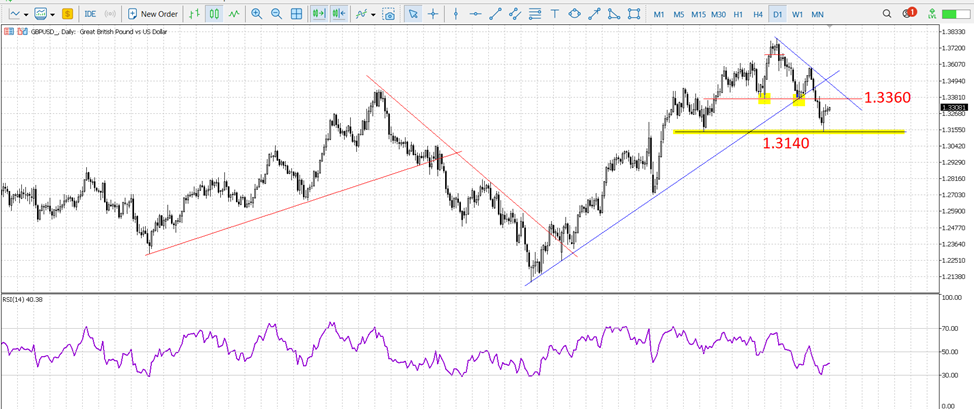
The GBP/USD pair trade is moving in a downtrend after breaking the support level at 1.3360. After breaking the previous uptrend, it now has major support at 1.3140 and major resistance near
1.3450. Therefore:
- Trend: Downtrend
- Support at: 1.3140
- Resistance at: 1.3450

-1724934015.webp)

-1751465072.webp)

