




Global markets are closely monitoring trade agreements with the United States, particularly those expected to be with major economies, led by the European Union.
US Commerce Secretary Howard Lutnick indicated that he does not rule out reaching a satisfactory agreement anytime soon. This week is generally quiet in economic data, except for the European Central Bank's meeting to decide on interest rates, which is expected to hold off on a rate cut after eight.
The Japanese economy is also witnessing parliamentary elections, with preliminary results indicating that the ruling coalition in Japan, which won last year, is strongly expected to lose control of the upper house. This would weaken Prime Minister Shigeru Ishiba's grip on power as the deadline for the US to impose tariffs on Japanese goods approaches.
Main keywords
- The European Central Bank is meeting to decide on interest rates for the euro. Will it stop cutting rates?
- Markets are focusing on potential trade agreements, especially with major economies like the European Union and India
- Japan faces important Senate elections, with signs that the ruling party coalition will almost certainly lose control of the chamber amid difficult economic times and anticipation of an urgent trade agreement with the US.
Economy Spotlight: Trade Agreements with the US Under the lens
First, the US economy:
The issue of tariffs continues to dominate the public scene, especially with the return of tariffs affecting numerous goods and parties alike, including the European Union, which has been threatened with 30% tariffs.
According to the Financial Times, US President Donald Trump has called for a minimum tariff of 15-20% on any potential agreement with the European bloc. Trump has also confirmed that he will maintain the tariffs imposed on the auto sector at 25% as planned.
The US administration continues to emphasize that efforts are underway to conclude trade agreements, the most recent of which was with Indonesia, with which Trump indicated he had reached an agreement requiring tariffs of approximately 19%, a rate that India seeks to reach with the US soon.
Regarding economic data, US data so far has shown limited impact from US President Donald Trump's fiscal and trade policies.
The latest labor data indicates that the US labor market remains resilient, and that US companies have not yet begun laying off workers.
Despite the return of inflation, specifically the Consumer Price Index (CPI), to its upward trend, financial market indices remain resilient, even reaching record highs, particularly the Standard & Poor's 500 and the Nasdaq.
This is supported by business results and positive news for Nvidia, which returned to the Chinese market after a months-long hiatus following Trump's ban on chip exports to the Chinese market.
Although inflation rose from 2.4% to 2.7% year-on-year, the Producer Price Index (PPI) contradicted the notion of a direct impact from tariffs, declining from 2.7% to 2.3%.
However, analysts and markets were awaiting the retail sales index to gauge the most direct impact of the tariffs.
US retail sales rebounded more than expected, interpreted as a reflection of higher commodity prices rather than a rise in sales volume. They rose from -0.2% to 0.5%.
Next week, the US economy awaits the Federal Reserve Chairman's speech at the "Integrated Capital Framework Review for Large Banks" conference, which the Fed will host on the 22nd of this month.
Observers will be awaiting any comments from Powell or any specific guidance on monetary policy and expected interest rates in the near term.
Second. European Economy:
Despite the European Union's openness to trade negotiations with the US, and even the US President's confirmation of this, European officials have prepared a list of retaliatory tariffs against US tariffs.
These tariffs target vital goods, including cars, aircraft, and agricultural products, valued at more than $80 billion, down from the initial list of more than $95 billion.
Analysts and observers continue to stress that US tariffs will burden the European economy through numerous pressures.
The European Union's executive body, for its part, proposed a long-term budget of two trillion euros, focusing on addressing external competition and geopolitical risks in the so-called defense budget. However, Germany had a different view, rejecting it, considering the plan unacceptably large.
The German government also criticized the plan to impose additional taxes on large companies among the new funding proposals put forward by the European Commission.
The European Central Bank, for its part, is preparing to make its decision on interest rates, with expectations that it will not cut them, and will hold them at 2.15%.
Third: The Japanese Economy:
For the second consecutive month, Japanese exports declined as US tariffs hurt the auto sector. Pressure is expected to increase on the country, which is still struggling to reduce inflation and raise interest rates to save the currency.
Despite the slight decline, the Japanese economy continues to record a cumulative trade deficit amid the threat of US tariffs.
Japan also continues to suffer from uncertainty regarding the trade agreement with the US, especially since US President Donald Trump has renewed his threat to impose tariffs of approximately 25% on Japanese imports starting August 1.
However, the Japanese side continues to confirm that it is continuing trade negotiations between its chief negotiator and US Secretary of Commerce Howard Lutnick.
Fourth: The Chinese Economy:
In a surprising precedent, Chinese President Xi Jinping issued a warning to Chinese officials against excessive investment in artificial intelligence and electric vehicles, amid fierce price wars fueling deflation in the world's second-largest economy.
The warning coincided with a rise in investment in artificial intelligence and electric vehicles, while investment in other key industrial sectors, such as construction, steel, cement, and solar energy, declined.
In terms of economic data, China's GDP data indicated year-on-year growth of 5.3% in the first half of this year, driven by strong industrial production, strong exports, and directed investment, despite declines in domestic consumption, real estate, and public and private investment.
With these economic data, which defied expectations of a decline, pressure continues on the Chinese government to transform this growth into a sustainable, broad-based recovery, not one specific sector.
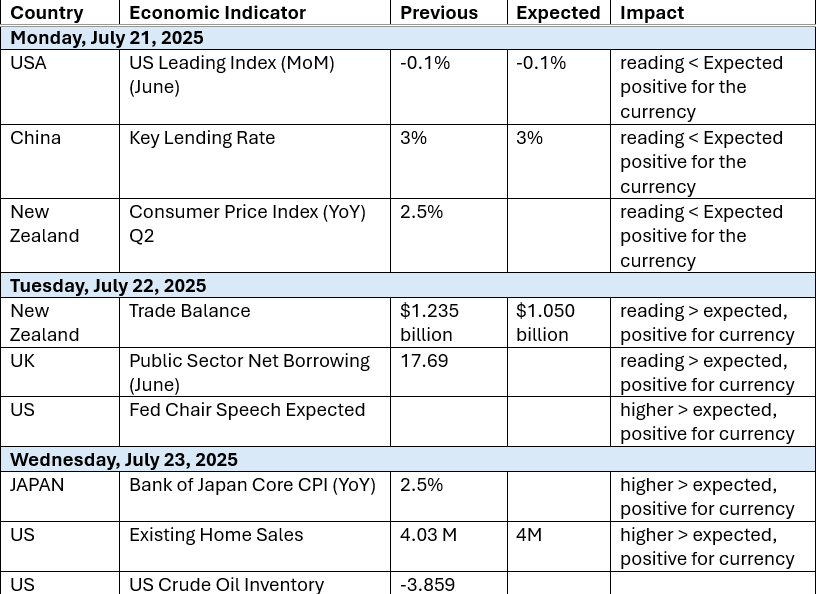
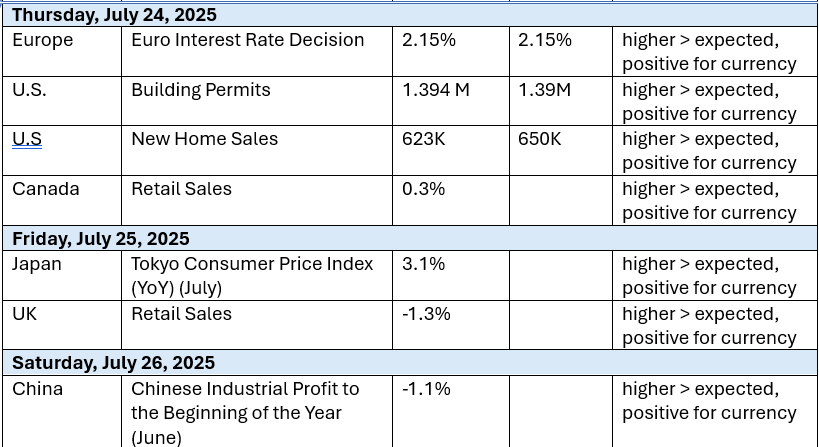
Economy Spotlight. Economic Calendar and What to Expect in the Markets Next Week Following US Trade Agreements:
Global markets will be awaiting the following economic data:


-Impact-on-Dollar,-Rates-&-Gold-1790852763.webp)