



-1751268192.webp)
Introduction:
Markets are focusing on the speech of the US Federal Reserve Chairman at an economic summit in Europe, amid ongoing tensions between him and US President Donald Trump. Markets are also watching Trump's tax bill until July 4, which could be a very important date for everyone.
In this issue of the Financial Markets Report, we highlight the Japanese economy, where election campaigns are underway, and other important issues for the Japanese economy, as well as other economies experiencing a particularly important period, especially as the end of Trump's tariff suspension period approaches.
Main keywords:
- Markets will be monitoring the US Federal Reserve Chairman's speech at an event in Europe.
- Markets are monitoring Trump's tax bill, specifically until July 4, which Trump previously set as the date for its passage.
- The British economy may be heading toward a tax cut for car exports to the US market.
- Pakistan is talking about a fruitful trade agreement with the US, the US announces the proximity of wholesale agreements, and Trump cuts off important trade talks with Canada.
Economy Spotlight. Markets Watch Trump's Tax Bill
First, the US economy:
The US economy confirmed its contraction during the first quarter of this year, marking the first time in three years. This was confirmed by the final revision of the GDP reading, which recorded a contraction of -0.5%. This confirms the impact of the tariffs imposed by US President Donald Trump on imported goods during this period.
In turn, US consumer spending, which accounts for more than two-thirds of economic activity, unexpectedly declined in May as the boost from preemptive purchases of goods such as cars before the Trump administration-imposed tariffs faded.
Meanwhile, monthly inflation maintained a moderate pace of increase.
The US economy concluded last week with one of the Federal Reserve's favorite inflation figures, rising on a monthly and annual basis in line with expectations, rising from 2.2% in April to 2.3% year-on-year in May.
In light of the current economic data, market anticipation is growing day by day as the expiration of the tariff suspension approaches, amid uncertainty resulting from conflicting news regarding trade agreements between the United States and several international partners. While Pakistan expressed its willingness to conclude a mutually satisfactory trade agreement, US President Donald Trump indicated positive progress in talks with India regarding an imminent trade agreement.
In another positive development, markets were boosted by the US reaching an agreement with China regarding the export of rare earth shipments. This was in addition to statements by US Treasury Secretary Scott Besant, who confirmed the possibility of reaching several trade agreements before the Labor Day holiday on September 1, noting that negotiations were underway with 18 major trading partners.
Amid these positive indicators, a surprising negative development occurred when President Trump announced the suspension of trade talks with Canada, citing its imposition of taxes targeting American technology companies. He described this as a "blatant attack" and announced his intention to impose new tariffs on Canadian goods next week.
The global economy will also be on the rise again with a speech by US Federal Reserve Chairman Jerome Powell at the European Central Bank's 2025 Forum on Central Banking in Portugal. With this speech, markets will be eagerly awaiting key economic data related to the labor market, such as the job openings index, the unemployment rate, and average wages. They will also be anticipating what could happen before July 4, which Trump has said will be the date for implementing his tax bill after a final version was voted on by the Senate last Saturday evening.
Note: US financial markets will be closed on Friday, July 4, for the Independence Day holiday. Trump has threatened to cancel Congress's recess if the tax bill is not passed.
Second. European Economy:
A series of news and events affecting the European economy, including potential trade agreements with India, an indicator warning of imminent danger facing European companies, and some positive signs from the bloc's economy this week.
The Weill European Economic Distress Index (WEDI) indicated that the retail and consumer goods sectors are the most affected sectors in Europe, and that financial distress levels have now reached their highest levels since the global financial crisis due to tighter credit, cost inflation, and weak consumption. This index uses data from more than 3,750 European companies to monitor 16 indicators that reflect the symptoms of financial distress that European companies may be facing.
The European Union is preparing to receive a delegation from India in July to finalize free trade agreements that will boost exports and eliminate tariffs. This visit includes, in addition to the European Union, the United States and the United Kingdom.
For its part, the European Union unveiled the "Vision for a European Space Economy," an initiative aimed at positioning the EU at the forefront of the global space economy by 2050.
This is the latest effort by the EU to revitalize its economy and return it to the forefront of the economic scene by raising levels of unity among member states.
Third: The Japanese Economy:
The Japanese economy felt some relief last weekend after one of the inflation indicators, the consumer price index, fell to 1.8% for June, and the Tokyo Consumer Price Index fell to 3.1%, the first decline in four months.
This reinforces the expectations of the Japanese government and the Governor of the Bank of Japan, who indicated that inflation is on the right track. Regarding the ongoing trade negotiations with the US, Japanese tariff negotiator Ryusei Akazawa visited the United States on Thursday for the seventh time to negotiate tariffs.
Japan is still borrowing a mechanism to reduce the rate of tariffs on cars based on the percentage of countries' contributions to the US auto industry. However, no specific announcement has yet been made regarding these negotiations.
For their part, some Bank of Japan policymakers have called for keeping interest rates steady for the time being, given the uncertainty surrounding the impact of US tariffs on Japan, especially given the general decline in sentiment.
Japan's auto sector remains the hardest hit, with a decline in car exports from Japan to the United States being the main reason for Japan's exports falling in May this year for the first time in eight months.
Japan is also witnessing the official start of the election campaign, which begins on July 3 and continues until July 19, the day before the House of Councillors elections, the upper house of the Japanese parliament. Important economic issues dominate this election, including the cost of living, economic growth, stagnant wages, and social security.
Fourth: The Chinese Economy:
The Chinese economy is still struggling to address its internal economic problems, particularly weak household consumption and the potential threat to the automotive industry considering rising external competition and potential controls imposed by foreign countries on Chinese cars.
This is in addition to the external challenges represented by US tariffs, which were clearly discussed at the China Davos 2025 Forum. Despite the resilience and cohesion that the Chinese economy continues to demonstrate in the face of these domestic and external challenges, some economic indicators released by the Chinese side last week confirmed some headwinds.
Profits of industrial companies declined by 1.1% in the first five months of this year compared to the previous year. This is attributed to the recent decline in global commodity prices, which negatively impacts the profit margins of companies, particularly industrial ones.
Despite these internal and external challenges, the Chinese economy continues to deliver a cohesive and resilient performance, driven by two main drivers: advanced technological development and support for traditional industries and their advancement.
This resilience is evident in several indicators, most notably the services Purchasing Managers' Index (PMI), which remains above 50, the benchmark between contraction and recovery.
Meanwhile, the Chinese economy will await key economic indicators to confirm the extent of resilience, most notably the manufacturing PMI, especially with the announcement of a trade agreement that will expedite the resolution of the tariff issue between the two countries and restore trade calm in a way that will support the Chinese economy, which is moving day by day toward discussing its new five-year strategy for the next four years until 2030.
Economy Spotlight. Economic Calendar and What to Expect in the Markets Next Week:
Global markets will be awaiting the following economic data:
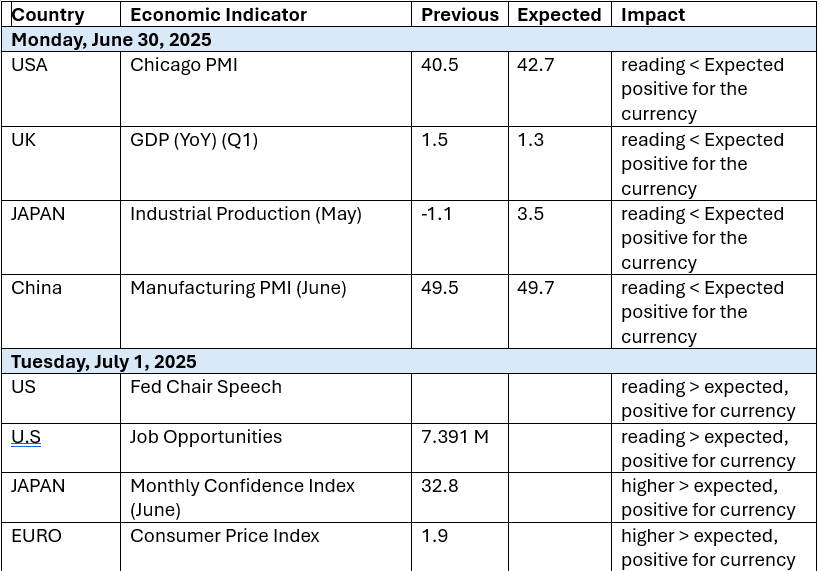
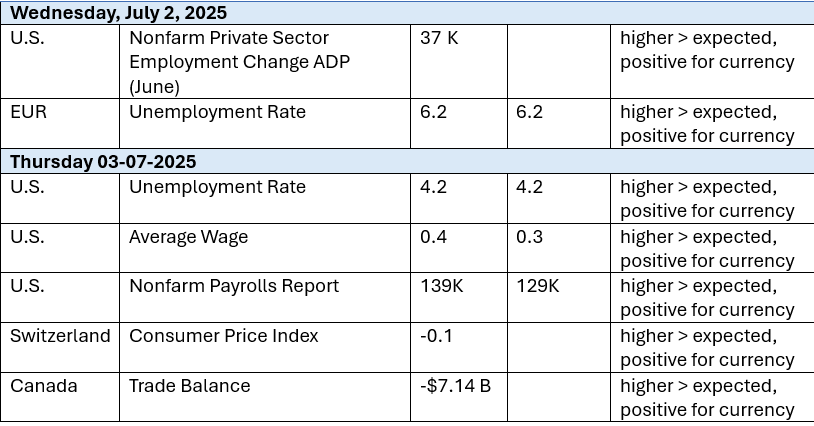


-Impact-on-Dollar,-Rates-&-Gold-1790852763.webp)