



-1751887297.webp)
The global economy is eagerly awaiting this week, as the July 9 U.S. Tariff deadline for the suspension of US tariffs approaches. This comes amid positive news about agreements being reached with various countries and Trump's unified message to dozens of countries, with tariffs that are narrow compared to the high ones he imposed on April 2.
The global economy will also focus on the BRICS meeting, given the declining status of the dollar and concerns about US fiscal policy. Analysts and observers will monitor how the group will address these challenges and how they can be leveraged to revive the dream of a single BRICS currency, in addition to leveraging the trade benefits of a larger number of countries wishing to join the group.
Analysts will also review the minutes of the Federal Open Market Meeting (FOMM) of the previous meeting, in which the Fed left interest rates unchanged, stressing that future rate hikes will be more closely and precisely dependent on economic data, particularly in the labor market, given the threat of US tariffs.
Main keywords
Global financial markets are focusing on July 9, the expiration date of the US tariff suspension period.
Analysts are monitoring trade agreement announcements, especially in light of the stalled agreements between the US, the European Union, and Japan, and Trump's sending of letters with specific tariffs to 12 countries without disclosing their names or the size of their new taxes.
An upcoming three-day BRICS summit will be held in Brazil. Will the single currency be discussed again, given the decline in the dollar's standing and confidence in it due to US tariffs?
Economy Spotlight. U.S. Tariff deadline under the microscope
First, the US economy:
The US economy witnessed a busy past week, with economic data related to the labor market on one hand, and the decision regarding Trump's tax bill on the other.
This coincided with the US Federal Reserve Chairman's speech at a European Central Bank event in Portugal, in which he emphasized that the Fed is still awaiting more stable economic data before beginning the process of reducing interest rates.
The US economy also witnessed several agreements, most notably the announcement of a trade agreement with Vietnam, which reduced tariffs from 46% to 20%, while maintaining the 40% tariff on goods transiting through Vietnam for export to US markets.
An Indonesian official indicated that his country was close to signing a $34 billion trade agreement before the scheduled date for suspending tariffs on July 9, which Trump confirmed he would not extend beyond that date.
Trump concluded last week by confirming that Washington would begin sending letters to countries that set tariff rates on their imports to the United States, with the possibility of sending collective letters to several countries at once, with the potential for tariffs to be imposed between 20% and 30%. Economic data, particularly regarding the labor market, was mixed, suggesting that the Federal Reserve will need time to return to lowering interest rates.
The ADP non-farm payrolls contracted 33,000 jobs, the first time since January 2022. This indicates that the sector was significantly impacted by Trump's tariffs, which led to widespread layoffs at companies.
However, despite this contraction, the unemployment data and the number of non-farm payrolls were a surprise. The US economy added more jobs than expected, while the unemployment rate fell to 4.1%, while income indicators declined slightly.
Despite the strength shown by the US economy in these data, economists and analysts believe that the jobs added were qualitative, i.e., related to selected sectors, which cannot be relied upon to measure the impact of Trump's tariff policies on financial markets.
The US economy is expected to have a quiet week in terms of economic data, with the minutes of the Federal Open Market Meeting being the most prominent data that analysts and observers will be watching
With this anticipated news, markets will be in a very sensitive period until Wednesday evening. News of positive responses from countries to Trump's messages, while not escalating tensions between the BRICS countries and Trump, will be a boon for risk assets, unlike safe havens like gold.
Second. European Economy:
The European economy is one of the few major economies, along with Japan, that has yet to reach clear trade agreements with the United States.
The European Union is seeking a preliminary agreement with the United States before the US tariff deadline next Tuesday, July 9.
Europe also hosted a meeting of central bank governors in Portugal, during which they emphasized discussing all means to improve Europe's competitiveness with the United States and China.
This now represents an important pillar in concluding a trade agreement with the United States and discussing bilateral trade relations with China without harming European economic sectors, especially with the approaching Europe-China meeting later this month to discuss improving relations and resolving economic and trade disputes.
To maximize its competitiveness, the European Commission has launched several initiatives to accelerate the European economy's transition to a circular economy, which is expected to be enacted into law next year. This law encourages the reuse, recycling, and remanufacturing of materials.
Regarding energy developments, which Europe begins planning its stockpiles for this winter season, recent reports indicate that Russian natural gas exports to Europe have fallen to their lowest levels in fifty years, marking a strategic shift in a sector that had been Europe's primary energy source. Central bank governors meeting in Portugal this week focused on ways for Europe to improve its competitiveness with the United States and China.
Third: The Japanese Economy:
After eleven weeks of negotiations across seven rounds between the Japanese and American sides, Japan has still not been able to reach a comprehensive trade agreement with the US to overcome the tariffs that significantly threaten Japanese economic growth, particularly those related to the 25% tariffs imposed on Japanese cars.
Analysts indicate that Japan must expedite the conclusion of a trade agreement before the deadline set this week or work to extend the deadline for US tariffs on Japan, especially since the US is Japan's second-largest trading partner after China, exporting approximately $148 billion to the US market.
Japan's need for a trade agreement is growing amid the continued threat of high inflation and rising prices for one of the most important commodities for Japanese families, rice. Regarding economic data, household spending was one of the positive indicators last week, rising by the largest amount since 2022, reaching a record 4.7%.
This was supported by spending on Japanese-made cars. This reflects the positive impact of US tariffs, which stimulated weak domestic demand among Japanese consumers.
Fourth: The Chinese Economy:
China is preparing to participate in the three-day BRICS summit in Brazil. This summit coincides with issues that could be exploited by the summit, specifically the declining status of the US dollar considering US trade threats.
The BRICS summit's ambition to issue a single currency has long clashed with the dollar's global power and dominance.
China is participating in this summit in a favorable economic position, especially given the temporary trade truce with the US.
China has demonstrated new flexibility that could lead to a permanent trade agreement, offering to discuss the terms of a trade agreement with the US within the World Trade Organization.
Analysts have indicated that China must continue to stimulate its economy to achieve its goal of a growth rate of around 5% for the current year, a rate that is feasible given the economic flexibility. The Chinese economy will also be expected to release trade balance data for June, with expectations of a slight improvement.
This reading has declined compared to the largest reading recorded in February, when the Chinese economy recorded its largest trade surplus in more than 25 years, recording $170 billion at the time.
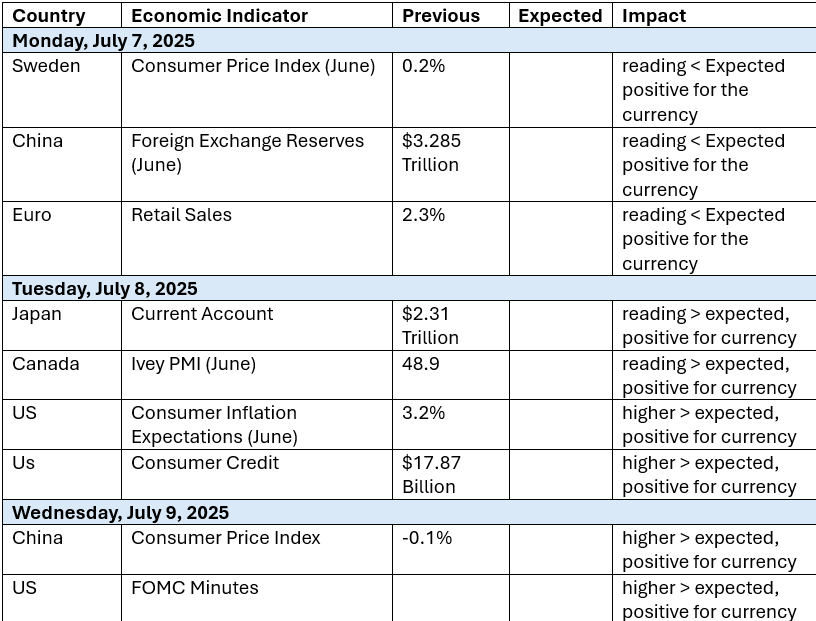
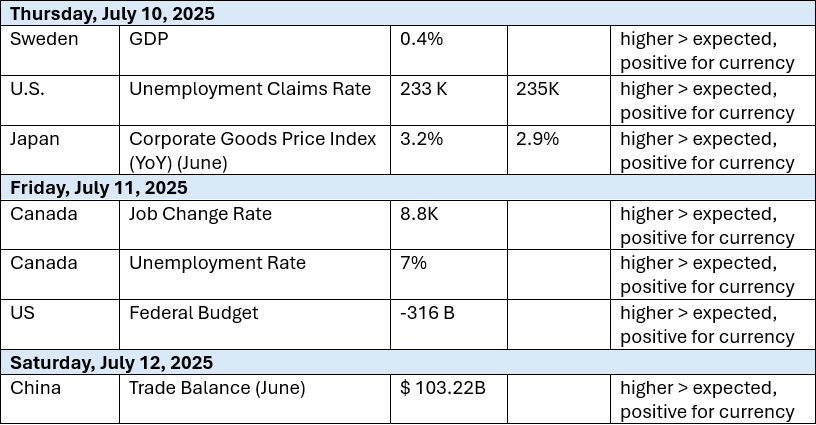
Economy Spotlight. Economic Calendar and What to Expect in the Markets Next Week:
Global markets will be awaiting the following economic data:


-1786712547.webp)
-1724934015.webp)