



What Is the Jackson Hole Symposium?
The Jackson Hole Economic Policy Symposium is an annual conference hosted by the Federal Reserve Bank of Kansas City in Jackson Hole, Wyoming.
It brings together leading policymakers and economists to discuss major economic issues, including inflation, interest rates, employment, economic growth, and monetary policy.
The symposium began in 1978 and has been held in Jackson Hole since 1982, becoming one of the world's most closely watched central banking events.
Unlike an FOMC meeting, Jackson Hole does not include an official interest-rate decision.
FOMC Meeting → Monetary-policy decisions are made.
Jackson Hole → Economic challenges and the future direction of policy are discussed.
While policymakers do not change interest rates at the symposium, their speeches can provide important insights into how they see the economy and how policy could develop in the months ahead.
Who Attends?
Around 120 participants typically attend the symposium each year, including:
- Central bankers and Federal Reserve officials
- Economists and academics
- Government representatives
- Financial-market participants
- Selected members of the media
Bringing these groups together creates an opportunity to exchange views on the global economy, financial markets, and the challenges facing monetary policy.
How Often Does It Take Place?
The Jackson Hole Symposium takes place once a year, usually toward the end of August.
Each year focuses on a specific theme based on an important economic or policy challenge.
In 2026, the symposium will take place from August 27–29, with the theme:
“Financial Innovation: Implications for Payments and Policy.”
This year's theme looks at how new financial technologies and changes in the way money moves through the economy could affect payments, financial markets, and central-bank policy.
Why Is Jackson Hole Important?
Jackson Hole matters because central bankers can use their speeches to communicate how their view of the economy is changing.
Markets therefore pay close attention to comments about inflation, interest rates, employment, economic growth, and future monetary policy.
For example, if the Federal Reserve sounds more hawkish than expected, investors may expect interest rates to remain higher for longer.
Hawkish Fed → Higher rate expectations → Stronger USD / Higher yields → Potential pressure on gold and equities
On the other hand, a more dovish message could increase expectations for lower interest rates.
Dovish Fed → Lower rate expectations → Weaker USD / Lower yields → Potential support for gold and equities
These relationships are not guaranteed, but they help explain why markets can react strongly to central-bank communication.
The important point is that markets react to changes in expectations. A speech does not need to announce a new policy to move prices. It only needs to change what investors believe the Fed could do next, as per analyst analysis. History provides several good examples.
How Jackson Hole Has Moved Markets
2010: More Stimulus
In 2010, the U.S. economy was still recovering from the Global Financial Crisis, while interest rates were already close to zero (Figure 1).
 Figure 1: U.S. Interest Rate (USINTR), 2010-2026, Yearly Timeframe. Source: TradingView
At Jackson Hole, then-Fed Chairman Ben Bernanke explained that the Federal Reserve had additional tools available to support the economy, including further purchases of longer-term securities.
His comments helped increase expectations that additional monetary stimulus could be coming.
A few months later, the Federal Reserve announced a $600 billion Treasury-purchase program, commonly known as QE2.
What Is QE2?
QE2 stands for the second round of Quantitative Easing. It was used because interest rates were already very low, leaving the Fed with limited room for further rate cuts.
In simple terms, the Fed bought large amounts of U.S. government bonds to push longer-term interest rates lower and encourage borrowing, spending, and investment.
Fed buys bonds → Yields fall → Borrowing becomes cheaper → Spending & investment increase → Economy receives support
This example shows why Jackson Hole matters: Bernanke did not announce QE2 at the symposium, but his speech helped prepare markets for the possibility of additional stimulus before the official decision.
S&P 500 Reaction to Jackson Hole 2010
Alongside improving economic data and stronger investor confidence, this helped create a favorable environment for equities. From around the time of the Jackson Hole speech through the end of 2010, the S&P 500 rose by roughly 10%, creating greater demand for equities (Figure 1).
 Figure 2: S&P500 (US500), 2010, Daily Timeframe. Source: TradingView
2022: Fighting Inflation
By 2022, the economic situation was very different.
U.S. inflation had reached multi-decade highs (Figure 3), and the Federal Reserve was aggressively raising interest rates. However, some investors were beginning to expect that the Fed could soon slow its tightening cycle.
 Figure 3: U.S. Inflation Rate YoY (USIRYY), 1984-2026, Yearly Timeframe. Source: TradingView
Powell used Jackson Hole to push back against those expectations. His message was clear: inflation remained too high, and restrictive monetary policy would need to continue even if it resulted in slower economic growth.
Markets reacted quickly.
The S&P 500 fell more than 3% on the day of Powell's speech, as investors adjusted to the possibility that interest rates would remain higher for longer.
It became one of the clearest examples of how communication from Jackson Hole can have an immediate impact on financial markets.
S&P 500 Reaction to Jackson Hole 2022
Following Powell’s Jackson Hole speech, the S&P 500 fell sharply as investors adjusted their expectations for interest rates (Figure 4). His message reduced hopes that the Fed would soon slow its fight against inflation, increasing expectations that rates would remain higher for longer. Higher rates can pressure equities by increasing borrowing costs and reducing the relative attractiveness of stocks, as per analyst analysis.
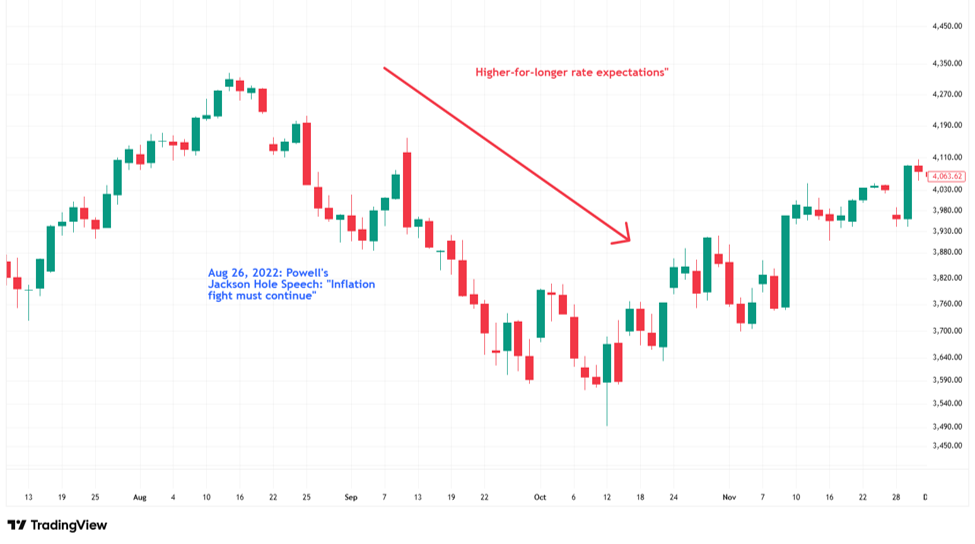 Figure 4: S&P500 (US500), Aug -Sep 2022, Daily Timeframe. Source: TradingView
Jackson Hole 2026
The 2026 Jackson Hole Economic Policy Symposium will take place from August 27–29, and this year's event will be particularly important as it will be the first Jackson Hole symposium under Federal Reserve Chair Kevin Warsh.
Warsh took over as Fed Chair in May 2026, succeeding Jerome Powell. This means investors will not only be watching the economic discussions, but also how the new Fed Chair communicates his views on inflation, interest rates, economic growth, and the future direction of monetary policy.
This is especially important because markets are still learning Warsh's communication style and policy approach. His comments at Jackson Hole could therefore help investors better understand how the Federal Reserve may operate under its new leadership.
At the same time, the official theme for 2026 is:
“Financial Innovation: Implications for Payments and Policy.”
What Is Financial Innovation?
In simple terms, financial innovation means new technologies, systems, and products that change how people and businesses pay, borrow, save, and invest.
Examples include:
- Instant and digital payments
- Stablecoins and digital assets
- Tokenization of financial assets
- Fintech and digital lending
- Artificial intelligence in financial services
- Faster cross-border payments
These developments can make financial services faster, cheaper, and more accessible, but they can also introduce new risks that central banks and regulators need to understand.
Why Does It Matter?
Payments are at the center of economic activity. Every salary, purchase, loan, or business transaction involves money moving through the financial system.
New technologies are creating faster and alternative ways for this money to move. For example, stablecoins and digital payment systems could reduce transaction times and costs, while fintech platforms could provide new ways for consumers and businesses to access financing.
However, this could also affect traditional banks. Banks rely on deposits to help fund loans. If more money flows toward alternative digital systems, central banks need to assess whether this could affect banks' funding, lending, liquidity, and overall financial stability.
How Could It Affect Monetary Policy?
When the Federal Reserve changes interest rates, those decisions reach the economy through the financial system.
For example:
Fed raises rates → Borrowing becomes more expensive → Spending & investment may slow → Inflationary pressure may decrease
This is known as monetary-policy transmission.
If technology changes how people borrow, save, invest, and transfer money, it could also change how quickly and effectively Fed policy reaches the economy.
This creates an important question for policymakers:
If the financial system is changing, could the way monetary policy works also change?
Why Should Investors Care?
The 2026 discussions could provide clues about how central banks plan to approach the next generation of finance.
Investors should watch for comments on stablecoins and digital assets, AI and fintech, the future role of banks, payment systems, and how these developments could influence monetary policy and financial stability.
In simple terms:
Financial innovation changes how money moves → This can affect banks and credit → Credit affects economic activity → And that can influence how central-bank policy reaches the economy and financial markets.
What Should Investors Watch in 2026?
While financial innovation is the official theme for Jackson Hole 2026, markets will also be listening closely for signals about the U.S. economy and the future direction of monetary policy.
Four areas will be particularly important:
Inflation: Is the Fed becoming more confident that inflation is under control?
Labor Market: Is employment remaining strong, or are signs of weakness becoming a greater concern?
Economic Growth: Does the Fed expect the economy to remain resilient or slow further?
Interest Rates: Do policymakers provide any clues about where rates could be heading next?
Ultimately, what matters is not only what policymakers say but also how their message compares with what markets expected before Jackson Hole.
What Could It Mean for Markets?
If policymakers sound more hawkish than expected, markets could increase expectations that interest rates will remain higher for longer:
USD ↑ | Treasury yields ↑ | Gold ↓ | Equities ↓
If the message is more dovish than expected, expectations for lower interest rates could increase:
USD ↓ | Treasury yields ↓ | Gold ↑ | Equities ↑
These are general market relationships rather than guaranteed outcomes, as economic data, positioning, and broader market conditions can also influence prices.
What Investors Should Remember
Jackson Hole does not need to deliver an interest-rate decision to move markets.
As history has shown, a speech can be enough to change expectations about the direction of monetary policy, and those expectations can quickly be reflected across currencies, bonds, gold, and equities.
For Jackson Hole 2026, investors will therefore be watching both sides of the discussion: how financial innovation could reshape the financial system over the longer term, and what policymakers are signaling about the economy and interest rates today.
The most important question will be simple: Did Jackson Hole change what markets expect the Fed to do next?
Sources:
https://www.kansascityfed.org/research/jackson-hole-economic-symposium/
https://www.century.ae/en/blog/jackson-hole-symposium-explained/