






The fundamental case for Bitcoin remains intact. What has shifted, however, is the direction of institutional capital. Over the past two years, the narrative of digital scarcity has been temporarily crowded out by a more tangible gold rush: the groudbreaking infrastructure buildout supporting artificial intelligence.
AI trade reordering priorities
The AI trade has reordered investor priorities. Instead of buying Bitcoin as a hedge against currency debasement, allocators have been rewarded for backing the physical backbone of the AI economy: hyperscalers, chipmakers, data centers, and power providers. Where Bitcoin’s scarcity narrative depends on discretionary, sentiment-driven demand, AI infrastructure spending converts directly into quarterly revenue — a far easier proposition for institutional capital to underwrite.
The sheer scale of the AI infrastructure cycle has crowded out competing assets. Fuelled by generative AI demand, Microsoft announced an unprecedented $80 billion capital expenditure plan for fiscal 2025. Meta followed with infrastructure spending guidance of $60 billion to $65 billion. Alphabet committed an estimated $75 billion, while Amazon’s annualized capex run rate exceeded $100 billion to support AWS and its AI ambitions.
This level of corporate spending creates a powerful, self-reinforcing equity cycle. Hyperscaler Capex quickly becomes revenue for companies such as Nvidia, Broadcom, and other key suppliers across the AI value chain. That revenue drives earnings upgrades, boosts market-cap concentration and attracts passive index flows, a virtuous circuit that Bitcoin, with no earnings, margin expansion story, or buyback program, simply cannot replicate.
Capex vs BTC price divergence
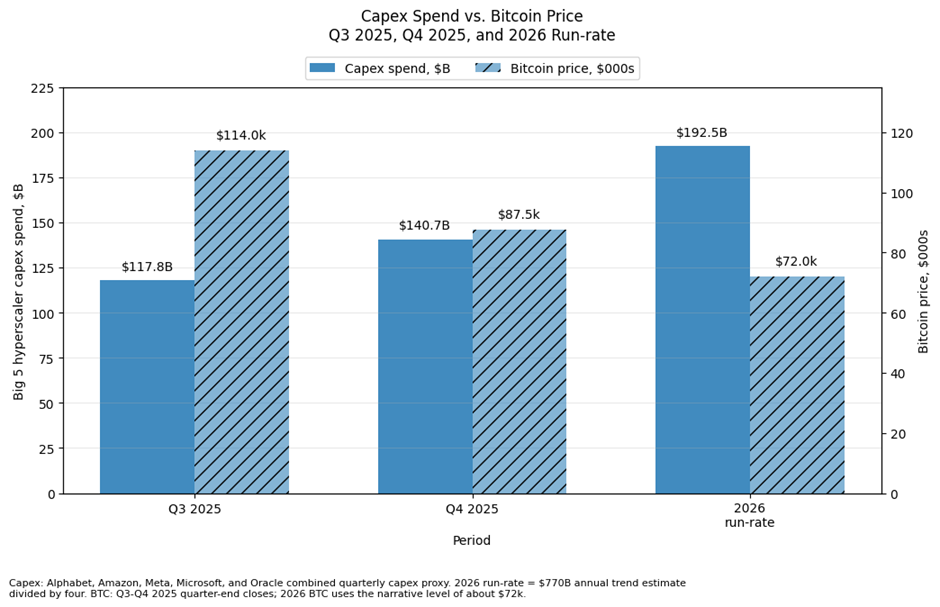
The divergence becomes clearer when the AI Capex timeline is placed beside Bitcoin’s price action. In Q3 2025, the five largest AI infrastructure spenders recorded a combined Capex proxy of $117.8 billion, while Bitcoin ended the quarter near $114,000. By Q4, spending had climbed to $140.7 billion, yet Bitcoin had fallen to about $87,500. By the 2026 run-rate, the contrast became sharper: estimated hyperscaler spending reached roughly $192.5 billion per quarter, while Bitcoin drifted toward $72,000.
This does not mean AI Capex mechanically pushed Bitcoin lower. The relationship is about capital preference. Each dollar committed to data centers, chips, and cloud capacity generates an immediate, traceable path from spending to revenue to earnings upgrades. Bitcoin offers something categorically different: a fixed-supply monetary asset whose upside depends on liquidity conditions, risk appetite, and long-term reserve conviction, none of which can be modelled in a quarterly earnings framework.
The chart reflects a tactical rotation, not a structural abandonment. Institutions have not discarded Bitcoin’s long-term monetary case; they have deprioritised it while the AI investment cycle offers a more immediate return profile. Until AI capex returns begin to normalise, or broader liquidity conditions ease, Bitcoin is likely to remain strategically relevant but tactically overshadowed by the compute trade.
HODLERS Are No Longer HODLing
For years, Michael Saylor’s message was simple: Strategy buys Bitcoin and never sells.
That stance turned the company into a proxy for Bitcoin and anchored its identity in the market. On June 1, 2026, that narrative shifted. Strategy disclosed it had sold a small portion of its holdings to meet internal obligations. In isolation, the move was minor relative to its overall position. But markets react to signals, not size. Bitcoin prices dropped quickly, triggering a wave of forced selling. The message was clear: the era of unconditional holding is no longer absolute. Even the most committed long-term players are beginning to manage positions more actively. In a market built on conviction, that shift matters.
Bitcoin Technical analysis
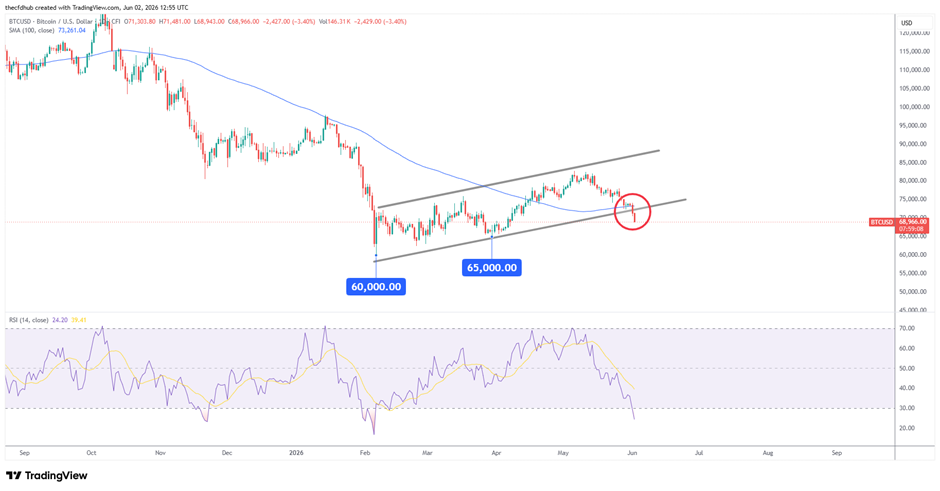
As of June 2 2026, at the time of writing, Bitcoin is testing the support of its ascending channel at $68,966, down 3.60% on the day, with the red-circled candle marking a clean rejection from the channel midline. The 100 SMA at $73,261 sits firmly overhead as resistance.
RSI at 24.20 is deeply oversold, a technical bounce is plausible, but momentum remains weak. This price action reflects the article's core thesis: Bitcoin has not broken structurally, but institutional capital continues favouring the AI infrastructure cycle over digital scarcity. Until liquidity conditions ease or AI capex returns normalise, BTC remains strategically relevant but tactically vulnerable, with $65,000 as the next key support.
-1789633462.webp)

-1787731465.webp)
-1787214523.webp)
-1724934015.webp)