




-1750244731-1761742239-(1)-1785046154.webp)
Introduction: A Decisive Week for Global Financial markets
Investors worldwide are bracing for a packed economic week, as meetings from three of the world's most influential central banks coincide with the release of highly sensitive economic indicators.
While the US Federal Reserve prepares to announce its interest rate decision amid escalating tensions in the Middle East, Europe awaits growth and inflation data alongside the Bank of England's rate decision. Meanwhile, attention in Asia turns to the Bank of Japan's policy meeting and China's industrial activity indicators.
Together, these events paint a comprehensive picture of the direction of global monetary policy amid renewed inflationary pressures, chief among them the recent rise in energy prices.
1. The US Economy: The Fed's Statement Matters More Than the Rate Decision
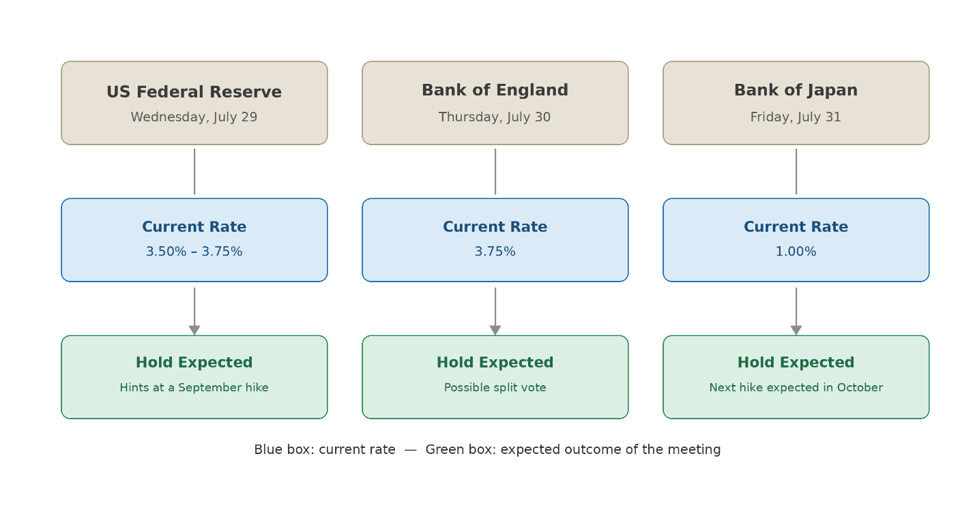
The Federal Reserve meeting, with results due Wednesday, tops this week's economic agenda. The Fed is widely expected to hold its benchmark interest rate within its current range of 3.50% to 3.75%, but markets will be focused on more than the number itself — specifically, whether the accompanying statement hints at a quarter-point rate hike at the September meeting, a scenario markets are currently pricing in.
The Fed Chair's Style and Its Impact on Market Expectations
Some analysts believe Fed Chair Kevin Warsh favors a terse communication style that avoids clear forward guidance, which could disappoint those hoping for explicit signals on the rate path.
Even so, this ambiguity isn't expected to shake the market's firm conviction that a September hike is coming, particularly amid rising energy prices and concerns that AI-related demand could reignite inflation. Some analysts, however, expect rates to remain steady through 2026 — but only if there is a swift, tangible de-escalation of US-Iran tensions.
Key US Economic Data to Watch This Week
• Personal Consumption Expenditures (PCE) index for June
• Second-quarter GDP (first reading), with growth expected to be modest
• June trade balance, with the deficit expected to narrow slightly
• Consumer confidence index, expected to hold steady
2. The European Economy: Patience on Inflation, Eyes on a September Move
The Eurozone and the European Central Bank
This week follows the European Central Bank's decision to hold rates steady at its last meeting, leaving the door open to a further hike in September after last month's increase.
Several senior economists view this as a gradual approach aimed at bringing inflation back to target without rushing, even though it has overshot that target for years, suggesting policymakers are willing to accept a slow return to target rather than resorting to aggressive tightening.
Key European Data Due Thursday and Friday
Thursday will be pivotal, with the release of:
• Second-quarter GDP figures for the eurozone's four largest economies, Germany, France, Italy and Spain, alongside bloc-wide data
• Preliminary inflation readings for Spain and Germany
• European Commission surveys on business and consumer confidence
• June unemployment data
Friday will complete the picture with:
• Preliminary inflation data for France, Italy and the eurozone
• Italian confidence surveys
Bank of England Decision: Will Rates Hold at 3.75%?
In the UK, the Bank of England's decision on Thursday stands out as the week's most closely watched domestic event. Markets widely expect rates to be held at 3.75%, with the Monetary Policy Committee likely split between a majority favoring a hold and a minority leaning toward a hike.
Given rising energy prices globally, some analysts believe the Bank will keep the door open to a future rate increase.
3. The Asian Economy: Japan Weighs Its Last Hike, China Watches Factory Activity
Bank of Japan's Policy Meeting
The Bank of Japan is expected to hold policy steady at its two-day meeting concluding Friday, as policymakers assess the impact of the last hike that brought rates to 1%.
The Bank will simultaneously release updated inflation and growth forecasts, with attention focused on whether these projections signal a change in the pace of monetary "normalization." Some analysts still expect the next rate hike in October.
Key Japanese Indicators Ahead of the Meeting
• Tokyo consumer inflation
• Industrial production
• Retail sales
• June employment data
China: Awaiting July's Purchasing Managers' Indexes
The week looks comparatively quieter in China, but attention will turn to July's Purchasing Managers' Indexes due Friday, which offer a read on business sentiment in the world's second-largest economy amid multiple pressures — from the fallout of Middle East tensions to ongoing trade frictions and the rapid pace of AI development.
Some analysts expect a slight decline in the official manufacturing PMI, reflecting a correction in some commodity prices and slower raw-material restocking, alongside a modest dip in the non-manufacturing index due to summer weather conditions.
Industrial profit data due Monday will also offer a mid-year snapshot of intense competition and price wars squeezing the margins of Chinese companies — a dynamic that has pushed many of them to expand into overseas markets.
Conclusion: What Should Investors Expect This Week?
This economic week marks a pivotal moment in shaping the direction of global monetary policy in the months ahead. With meetings from the Fed, the Bank of England and the Bank of Japan, alongside growth and inflation data from Europe and business indicators from China, investors will need to track every detail closely to understand where global markets are headed amid renewed inflationary pressures and rising energy prices.