





USD/JPY is again approaching the 160 level, erasing most of the gains from coordinated US-Japan intervention in July. The US government has been demanding that normalization happen sooner due to a higher-than-target inflation rate in Japan, which the BOJ has left unaddressed for too long.
Japanese policymakers, on the other hand, prefer a gradual process that does not affect the already fragile growing economy. This disagreement centers on whether currency intervention can ever be more than a temporary fix.
Japanese CPI prints have been running above the Bank of Japan’s 2% target for the past four years, while policy rates remain at a fixed 1%. The resulting difference with the dollar and euro continues to put pressure on the Japanese yen and is pushing investors out of the country in search of a better yield.
The Yield Gap Reality
There are three main explanations for this difference.
The first is Japan’s public debt, which exceeds 250% of GDP. Every 25-basis-point rate increase adds roughly $45 billion in annual spending, a burden no developed central bank has previously faced.
The second explanation lies in Japan’s need to import almost all of its energy. With the rise of oil and liquefied natural gas prices on the back of tensions in the Strait of Hormuz, most of today’s inflation is a pure terms-of-trade shock that cannot be solved by means of rate hikes.
The third aspect is politics, specifically the 2006 experience, which saw an early interest rate increase by the BOJ followed by an economic slowdown. Former prime minister Shinzo Abe even apologized for having supported such early monetary tightening, making it clear that there still exists a precedent for political opposition to normalization.
The Policy Trap
Without the structural change in the interest rate gap, currency intervention is unlikely to offer anything more than a temporary solution.
As evidenced by recent interventions by the Japanese authorities, their efforts were not enough for the yen to retain the achieved level. The yen soon gave back the gains and is again moving towards the 160 level.
Without any change in policies, the intervention was treated purely as a short-term measure by financial market participants.
Japanese authorities find themselves in a situation similar to a vicious circle. The unwillingness to decrease the yield gap prevents FX interventions from being considered as anything but a quick fix to the problem.
On the other hand, fast-rising rates could hinder the creation of capital that is necessary for further growth. Industries such as artificial intelligence infrastructural construction are the most at risk.
An Orderly Unwind
The alternative to shock therapy would be a smooth and orderly unraveling of the carry trade due to policy rate convergence on the Pacific.
With the FED reducing interest rates and the BOJ implementing gradual increases, a smaller yield spread will lead to Japanese money moving back to their shores as sovereign bonds begin to make sense for investors again.
This will lead to appreciation of the yen, making imports cheaper and curbing inflation without resorting to a drastic tightening of monetary policies that can lead to a recession.
Technical analysis
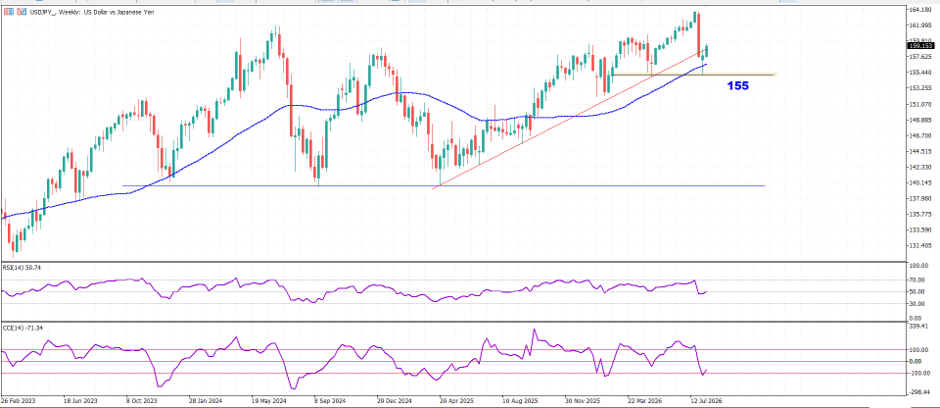
Levels near 155 are emerging as significant support levels, from which the pair has successfully rebounded by more than 1%.
Meanwhile, prices continued to trade above the 50-day moving average, indicating a continued upward trend for the USD/JPY.
-1791969153.webp)


-1791797000.webp)
-1791368114.webp)