




-1724934015.webp)
-1781274735.webp)
The euro gained ground after the European Central Bank decided to raise interest rates by 25 basis points to 2.25% at its latest meeting, marking the first rate hike since 2023. The decision came in response to rising inflationary pressures driven by higher energy prices, prompting the ECB to raise its inflation forecasts for the coming years while lowering its economic growth projections for the euro area.
ECB President Christine Lagarde emphasized that ongoing geopolitical tensions and their impact on energy prices continue to pose upside risks to inflation. She also noted that the central bank will remain data-dependent before making any further decisions regarding the future path of monetary policy.
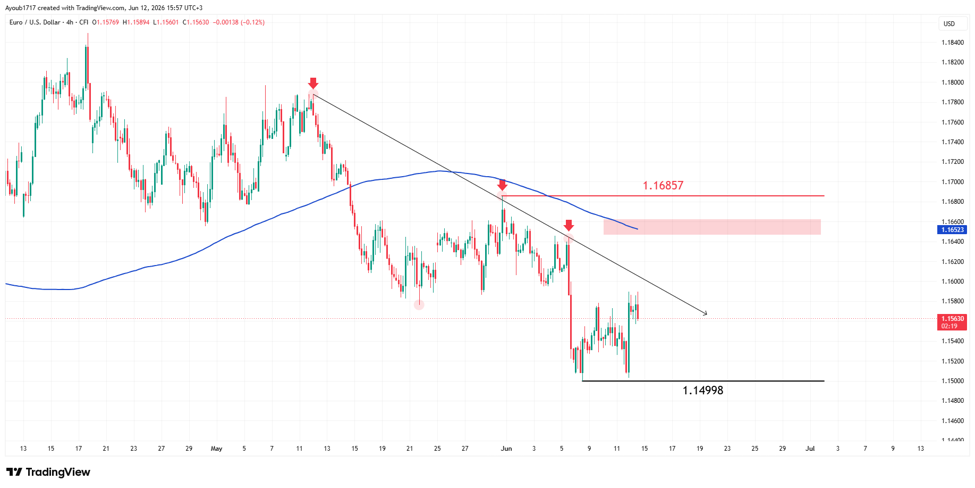 Figure: EURUSD, H4, TradingView
From a technical perspective, the EUR/USD pair remains in a broader downtrend on the four-hour timeframe, continuing to form lower highs and lower lows. The pair is currently trading within a range bounded by 1.16857, which represents the latest lower high, and 1.14998, the most recent swing low.
The recent rally has been supported by U.S. dollar weakness and the shift in the ECB's monetary policy stance. However, the move is still viewed as a corrective rebound within the broader bearish trend. The pair may continue its advance toward the red rectangle, which represents a significant supply zone due to its alignment with the 78% and 88% Fibonacci retracement levels, as well as its proximity to the 200-period simple moving average.
Traders should closely monitor the recent rally and the price reaction within the aforementioned supply zone. If the pair manages to maintain its bullish momentum and break above 1.16857, establishing a higher high on the four-hour timeframe, this could signal a shift in market structure from bearish to bullish, as per analyst analysis.
-1791446335.webp)


-1791368114.webp)

-1791359420.webp)