






Gold has entered an interesting technical setup. Following an amazing bullish rise that saw the commodity reach an all-time high level in late January 2026, the price has now retraced significantly and has entered into consolidation trading at around $4,173. The next move will probably be a significant price move, and the macro events lined up in the coming weeks will determine which direction gold will take.
The Technical Setup: Compression Before Expansion
On the daily chart, price is confined within a sideways channel, bound by a support level at $3,950 and a resistance level at $4,200 after undergoing an extended period of correction. Price is currently trading at $4,173, which is 2.34% higher for the day.
The key structural levels formed by volume and moving averages are:
Point of Control (POC): Volume has accumulated heavily around $4,093.25, forming a strong demand floor that provides immediate support if price pulls back.
Resistance: A move higher and a daily close above $4,200 would mean a break above the low-volume node zone with immediate exposure to the volume profile's upper value area boundary near $4,398.50. A move through that level, and separately through the descending 100-day moving average, would set the next major level of high-volume resistance between $4,500 and $4,700 within reach.
Momentum: The 14-day RSI is trading at 55.38 and has gone bullish with sufficient space above it but without getting close to overbought territory.
Downside Risk: If price breaks below the channel level support at $3,950 would invalidate the consolidation base with immediate support at $3,650-$3,750.
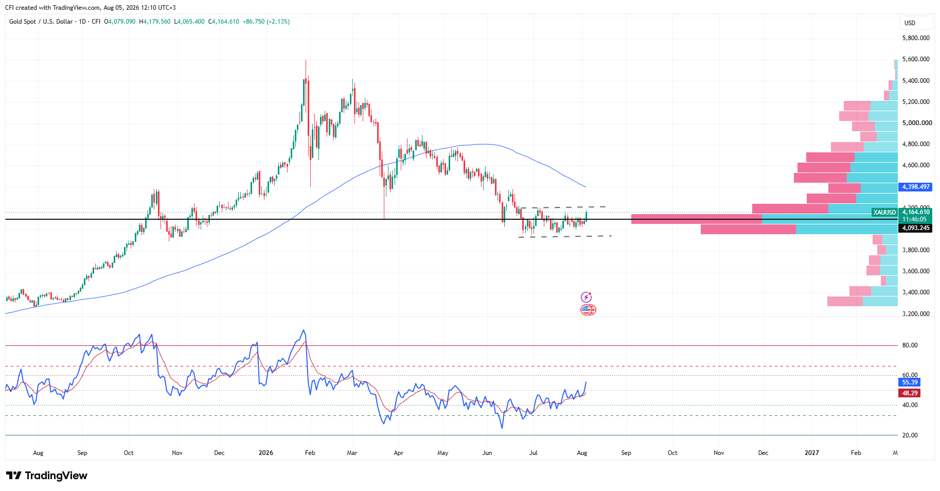 XAUUSD, Time frame: 1Day, Source: Tradingview
The Fed's Inflation Rethink: Five Task Forces
The single biggest catalyst for gold's next move is the Federal Reserve's restructuring of its monetary policy approach. Under Chairman Kevin Warsh, the Fed announced in July 2026 the creation of five independent task forces to examine core areas of policy, including one specifically on Inflation Frameworks, led by economists Greg Mankiw, Thomas Sargent, and William White. Despite the task force not having released any official reports, its formation implies that the Fed is now questioning whether its conventional approach will be able to handle the new economy that includes infrastructure spending on AI, supply chain reorganization, and constant price pressures.
Fed projections for mid-2026 reveal an unfavorable situation, where PCE inflation is projected at 3.6%, while core PCE is at 3.3%, both being significantly above the target level of 2%. Additionally, expectations for year-over-year inflation based on the NY Fed Survey of Consumer Expectations hold steady at 3.4%. With the Inflation Frameworks Task Force signaling their willingness to allow higher inflation to protect labor markets, real rates will fall rapidly even when interest rates are high. That is the ideal environment for gold. On the contrary, if the review prompts a renewed hawkish stance, the opportunity cost of holding non-yielding assets rises, and gold likely breaks down.
Geopolitics: Strait of Hormuz
Beyond monetary policy, gold's advance is also being supported by rising geopolitical tensions in the Strait of Hormuz. In recent trading sessions, gold prices have reacted sharply to developments suggesting either an escalation or easing of the conflict. This safe-haven demand exists independently of the real-yield dynamic and can drive gold higher even when the US dollar and interest rates remain firm. Traders should closely monitor any signs of a ceasefire or broader de-escalation.
The Dollar and Yields: The Twin Anchors
The negative correlation between gold and the USD and Treasury rates remains the main macro factor that affects gold's price movement. Currently, the 10-year Treasury yield is at around 4.63%, which is close to the top of the 52-week range.
The key dynamic to track is real yields. If nominal yields stay anchored near 4.6% while inflation expectations creep higher under the Fed's evolving framework, real yields fall, driving gold higher. However, if markets begin pricing in additional Fed rate hikes, real yields could spike and force gold to test its major $3,950 support floor. Simultaneously, a rising DXY above 102 would press gold lower.
Summary
Gold is not bullish or bearish at this point, according to analysts, but rather is coiled at a very important level. The outcome of the ongoing squeeze will be highly dependent on how incoming economic prints influence real rates and the U.S. dollar.
-1790754997.webp)



-1789980568.webp)