



-1764066112.webp)
When markets turn around the corner, traders typically grab for signposts that can help signal to them whether momentum is real (or if it is simply noise – fakeouts). Two of technical analysis’ most popular indicators are the Golden Cross and Death Cross. Sure, they may sound dramatic, but what you are really seeing is a visual cue for identifying periods where trends are gaining or losing momentum.
-1764065927.webp)
Understanding Golden Cross & Death Cross as trading patterns
What’s a Golden Cross?
To understand what each one means, how they form, and how to use them in your trading, lets understand first what’s a Golden Cross? A Golden Cross is considered a bullish signal, a potential indicator that an asset price could be entering a longer term uptrend. It happens when a short term moving average (most likely the 50 day) crosses above a longer term moving average (usually the 200 day).
Here's a visual example:
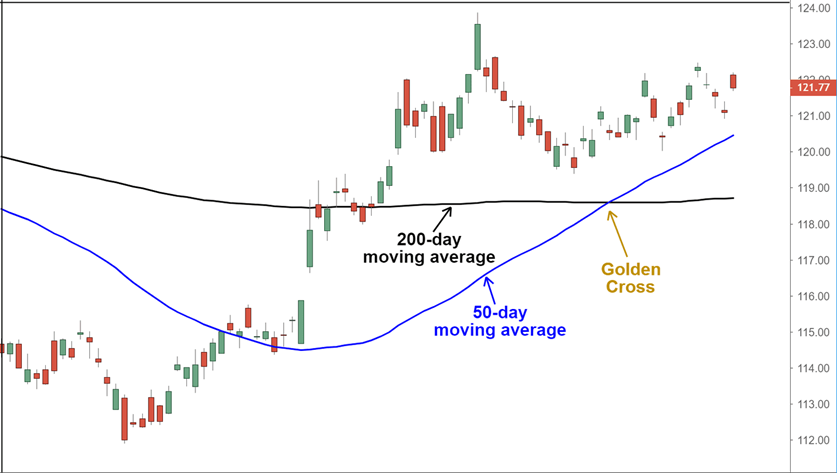
This crossover suggests that buying momentum is building, and many traders/ investors in Kuwait see it as confirmation that market is turning positive. It’s often noticed also by an increase in volume and a gradual shift in price structure AKA (price action) higher highs and higher lows .
What’s a Death Cross?
While it’s called a “golden” cross for a reason, it’s not an instant buy signal. It’s best used in combination with other indicators, like RSI ( Relative Strength Index) or trendline breaks, to strengthen the strategy idea and outlook.
Now on the other side, the Death Cross is a bearish signal that appears when the short term moving average crosses below the long term one. In simple terms, it suggests that selling pressure is outweighing buying interest, and a downtrend may likely be developing or accelerating.
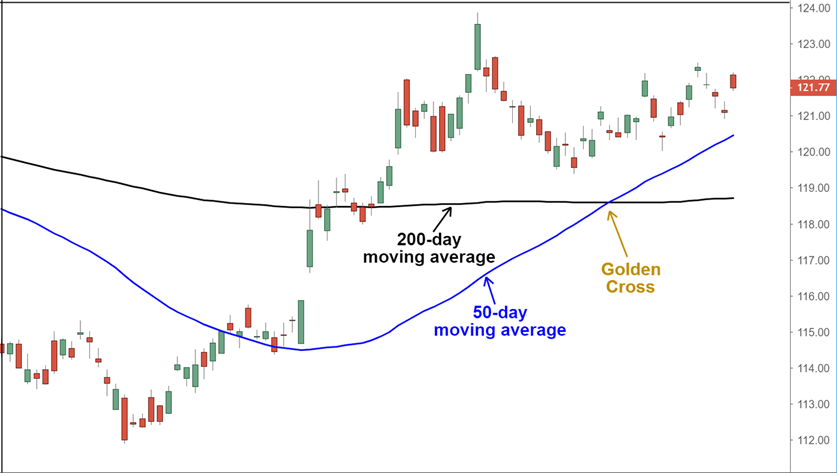
This pattern tends to form after a significant drop, where prices try to recover but fail to hold ground. When the faster average crosses under the slower one, it can be a sign that further downside is ahead. It doesn’t always mean a crash is coming, but it often warns of continued weakness or a change in overall trend.
Understanding How to Use Golden Cross Vs Death Cross Patterns in Trading
Both the Golden and Death Cross are trend-following signals, which means they’re more useful for confirming a trend:
- On longer timeframes like daily or weekly charts, these crossovers are considered more reliable. They help identify the direction of the overall trend.
- Volume can be a powerful confirmation. A crossover that happens alongside rising volume tends to carry more weight.
- Support and resistance zones should be watched closely. A Golden Cross near a key support may add conviction, while a Death Cross near resistance could reinforce a bearish setup.
- Some traders adjust the moving averages depending on their style like using 20-day and 100-day for swing trades, or 10-day and 30-day for intraday strategies.
Now, be careful, These are lagging indicators, which means they react to price, they don’t predict it. By the time a cross occurs, part of the move may already be underway. In sideways or choppy markets, crossovers can produce false signals (fakeouts) or “whipsaws,” leading to losses if traded blindly. They’re less useful in fast-moving or news-driven markets where fundamentals override chart setups.
NVIDIA’s stock as a case study
Just look at the price action in Nvidia, for example, around March 2025. At the time, the dreaded ‘Death Cross’ occurred and that’s just what we had in the 50-day simple moving average slipping below the 200-day moving average – a technical sign commonly associated with bearish momentum (see red arrow). But only a few months later, the stock trade took off again— this time boosted not just by sentiment in the market but strong fundamentals (earnings and sustained demand for AI sector). This recovery was soon reflected in the charts as Nvidia's stock formed a Golden Cross and began making fresh highs, as shown by the green arrow.
Learn Technical Analysis in Kuwait from CFI Academy!It is a perfect reminder that moving average crossovers indeed has its uses, but they are a lagging indicator. It shows the direction of price movement after it has already occurred. When you see a crossover, it often means the majority of an initial upward move may have taken place. And in cases like Nvidia, where the company was fundamentally performing well, the technical signal alone didn’t tell the whole story. In choppy or news driven environments, relying solely on these patterns can lead to false signals or (fakeouts) especially if not used alongside broader analysis.
To conclude:
Golden Cross and Death Cross patterns are simple but effective way to assess market direction. As stated before, Golden Cross points to growing bullish strength, while Death Cross warns of potential declines. Alone, they’re not flawless, but when used alongside volume, momentum indicators, and price action, they become more useful.
Rather than using these patterns as buy or sell entry signals, think of them as for example road signs. They don’t tell you exactly what will happen next, but they do help you understand where the market may be heading, and whether you’re trading with or against the trend.