





What Are Futures CFDs?
Futures are financial contracts that let you agree to buy or sell an asset in Bahrain at a fixed price on a future date. They are widely used across assets ranging from oil and gold to stock indices.

Unlike buying a stock or paying for oil today, a futures contract allows you to take a position now on what you think the price will be later. This makes futures popular for both speculation (betting on price moves) and hedging (protecting against price risk).
How do Futures work in trading?
Now, how do futures work? when you buy a futures contract, you’re not usually planning to take physical delivery of the underlying asset. Instead, most futures are settled in cash or closed out by entering an offsetting trade before the delivery date arrives. the mechanics look in practice:
1. Contract Date and Expiry
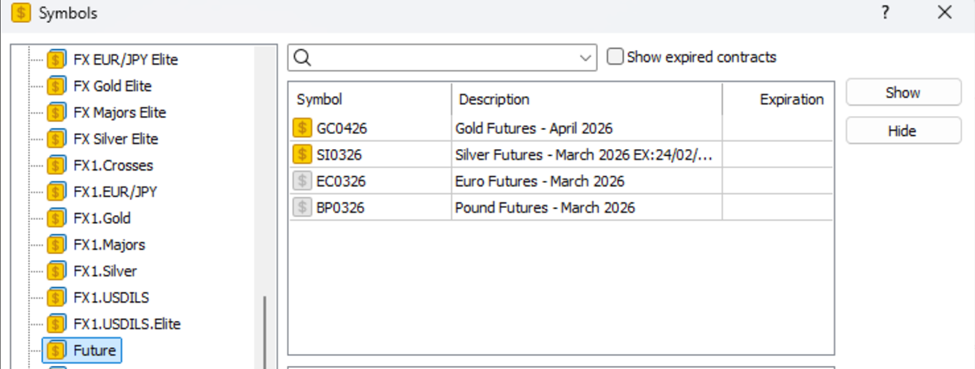
Each futures contract has a set expiry date. For example, Gold Future is set to expire on April 2026.
2. Leverage and Margin
Futures trading in Bahrain typically requires only a fraction of the total contract value upfront, known as margin. This means you can control a larger amount of the underlying asset with less capital, but it also increases the risk of gains and losses.
Explore Futures CFDs in BahrainLeverage and margin depends on each country jurisdictions and regulatory rules.
Why Traders Use Futures?
There are two main reasons:
Speculation: In which traders try to profit from price movements without owning the actual asset. For example, if you believe gold prices will rise by april, you might buy an April gold futures contract. If prices do go up, you can sell the contract at a profit before expiry.
Hedging: Usually producers, consumers, and businesses use it to protect against adverse price changes. For instance, an airline worried about rising fuel costs might buy oil futures to lock in a price now. This helps manage cost uncertainty.
Also, what makes futures unique and appealing:
- Standardised Contracts: Every futures contract has a set size, expiry date, and pricing unit. That consistency makes markets more liquid and transparent.
- Centralised Exchanges: Futures trade on regulated exchanges
- Leverage: Because only margin is required upfront, your potential gain or loss on price movement is magnified relative to your initial cash.
- Rolling & Expiry Management: Active traders often “roll” positions closing one contract before expiry and opening another further out to maintain exposure without physical delivery.
But, to keep in mind, trading futures is not the same as trading stocks or forex, as it requires Higher Leverage Means Higher Risk, Expiry Dates Matter a lot here, Unlike stocks, futures have a defined lifespan. You need to manage positions relative to expiration, and Costs and Fees can be an impact while futures often have tight pricing, exchanges and brokers may still charge fees.
Yet, futures markets serve as a mechanism across global financial markets. They help reflect real time expectations about economic growth, inflation, and central bank policy. Because they can be traded efficiently and offer exposure to hard commodities and financial benchmarks alike, futures are widely used by institutional investors, fund managers, and retail traders. Whether you’re hedging exposure, speculating on price direction, or diversifying your strategy, familiarity with futures opens up a broader trading opportunities.



-1763114932.webp)