





-1750664379.webp)
Introduction:
Financial markets are taking off amid rising geopolitical tensions in the Middle East, which are raising the level of economic uncertainty that still exists. Alongside these economic developments comes US Federal Reserve Chairman Jerome Powell's semi-annual testimony before the House Committee on Economic and Financial Services.
This important report also covers the most important developments in major economies, including Europe, which is still trying to reach a trade agreement with the US, and Japan, which is facing a crisis in a basic commodity that is essential to Japanese citizens.
Main keywords:
The Federal Reserve Chairman testifies before the US Congress over two days at the beginning of this week.
US equity funds record their largest quarterly outflows.
Initial news about the possibility of Europe accepting lower tariffs from the US.
A new economic crisis is looming over the Japanese economy and consumer.
Economy Spotlight. US Federal Reserve Chairman Jerome Powell Testifies in June 2025
First, the US economy:
Last week, the US economy witnessed the Federal Reserve's fourth meeting of the year, during which interest rates were kept unchanged, with expectations of two rate cuts in 2025. Inflation is expected to stabilize at 3% this year and decline to 2.4% next year, as part of its commitment to returning inflation to its target level of 2%. Regarding Trump's latest projects, last week witnessed amendments to some provisions of the Trump reduction bill by the Senate after the House of Representatives had previously passed the bill. This represents a new challenge to the bill, which Trump has dubbed "the beautiful law." According to data from the London Stock Exchange, US equity funds recorded their largest weekly outflows in three months during the week ending the 18th of this month, at approximately $20 billion, amid Middle East tensions and continued concerns about the economic impact of rising oil prices. As for what the US economy awaits this week, one of the most important events will be the Fed Chairman's semi-annual monetary policy testimony before Congress, which will take place between June 24 and 25. Several important economic readings will also be released, most notably the latest revised reading of US GDP for the first quarter of this year, which is expected to remain contracting at -0.2%, following the consumer confidence reading, which is expected to rise slightly. Meanwhile, markets will focus on the core PCE price index reading for May, which stands at 2.5% year-on-year.
Second. European Economy:
Official European opinions continue to indicate the extent of the negative impact of Trump's tariffs, emphasizing that they will lead to losses for all.
This has prompted the European Union to hold meetings and visits with numerous economic stakeholders, the most recent of which was the European Central Bank President's visit to Beijing, to discuss the prospects for bilateral relations between the two economies, despite all the obstacles and challenges that remain.
Christine Lagarde described Chinese goods as a severe shock to the European economy. The International Monetary Fund, for its part, warned the European Union of the risk of economic recession if urgent measures are not taken to overcome slowing growth, weak investment, and growing geopolitical threats.
The Fund predicted that the eurozone economy would grow by only 0.8% year-on-year in 2025 and 1.2% in 2026. The French economy may be one of the major EU economies showing weak growth in 2025.
According to Bloomberg data, it may record lower than the eurozone average economic growth due to uncertainty about budget cuts and their impact on the economy. Although inflation in the European Union fell below the target level of 1.9%, data from the European Union's statistical office indicated that Romania had the highest annual inflation rate in the EU at 5.4%, reflecting the divergence in inflation conditions among EU countries.
Regarding trade negotiations with the United States, some analyses have indicated that the European Union is willing to accept tariffs of approximately 10%, which coincides with a complex negotiating position between the two sides.
Third: The Japanese Economy:
The Bank of Japan concluded its fourth meeting of the year, keeping interest rates unchanged while significantly reducing bond purchases.
This was considering ongoing trade uncertainty and additional concerns related to Japan's impact on Middle East tensions, given the importance of the Strait of Hormuz to the Japanese economy, as approximately three-quarters of the country's crude oil imports are shipped through this vital region.
The minutes of the Bank of Japan's meeting emphasized the increasing risks of an economic downturn, emphasizing that future interest rate hikes will depend on the trajectory of Japanese economic growth.
On another note, Japanese exports fell at their largest pace in eight months, recording a 1.7% year-on-year decline in May, the lowest reading since September 2024. Japanese exports to the US market also declined, particularly in auto shipments, which fell by about 25% compared to last year.
This decline was driven by US tariffs that affected the global auto sector by about 25%. Japan also faces another food security issue, as rice prices, a staple food for Japanese citizens, rose. The average price of a bag of rice rose by about 98% year-on-year due to a decrease in supply in the Japanese market.
Fourth: The Chinese Economy:
China witnessed an increase in one of its most important economic indicators, which reflects an optimistic outlook at the present time.
Retail sales and industrial output rose year-on-year in May, along with a rise in fixed asset investment, according to the National Bureau of Statistics.
Both sales and industrial production are important indicators of the health of the economy in terms of production and consumption, and these indicators have witnessed successive increases over the past three months.
However, the real estate sector remains contracting, with real estate investments declining by 10.7% during the first five months of this year.
With this latest economic data, China's National Bureau of Statistics released its forecast for economic growth for the remainder of this year, stressing that it is expected to remain stable despite challenges and trade tensions.
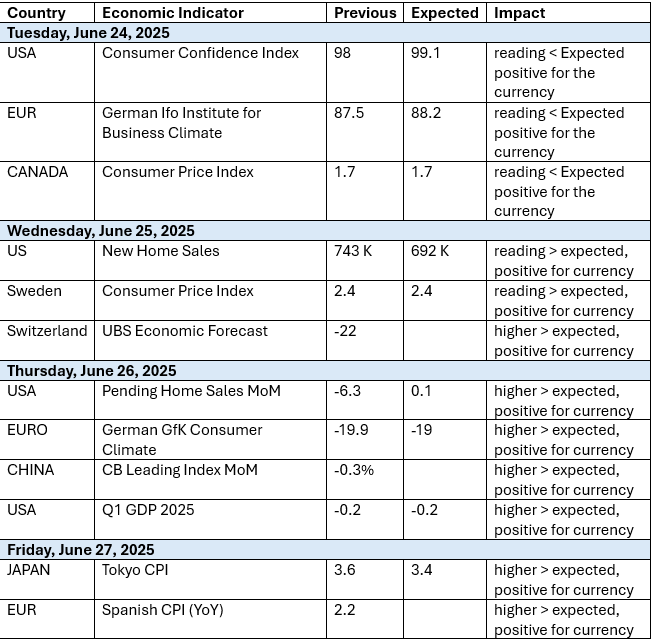
Economy Spotlight. Economic Calendar and What to Expect in the Markets Next Week:
Global markets will be awaiting the following economic data:


-1771242822.webp)