






Introduction:
Since the beginning of 2025, gold has set historic highs in many areas, including its historic price level, which is gradually approaching the $3,500 barrier as of April 22, and its quarterly price growth since it crossed the $1,000 barrier in 2007-2008.
Why do gold prices rise?
- Gold prices traditionally rise for several reasons, most notably:
- Low interest rates, a traditional relationship that doesn't necessarily apply permanently (which we'll explain later).
- During financial crises, investors leverage gold's safe haven status as a rare precious metal.
- Seasonal demand for gold increases.
To illustrate these reasons in practical terms, we will examine gold price's journey from its first breach of the $1,000 barrier in history, specifically after gold was de-pegged from the dollar in the 1970s, to the record levels it has been rapidly achieving since the beginning of 2025.
Gold Prices Analysis 2025: The Journey from $1,000 to $3,500
The First Station. The First $1,000:
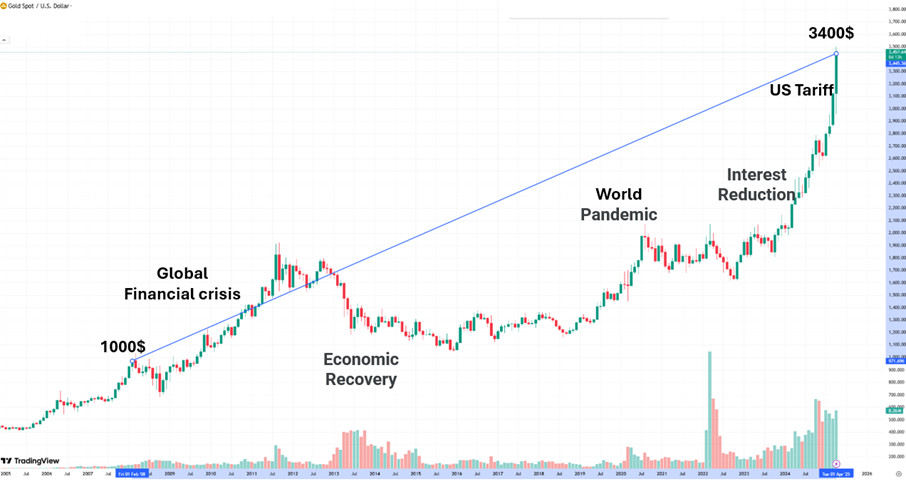
The previous chart reflects gold's journey from its inception to the first millennium, specifically since the global financial crisis of 2007-2008.
Gold rose to levels of $1,000 during that period after being used as a safe haven, fearing a prolonged economic recession, reminiscent of major financial crises (both the Great Depression of 1929-1936 and the stagflation of the late 1970s).
Gold continued to rise from 2007 until the end of 2011, a period during which the global economy was trying to regain its momentum.
Signs of recovery began to appear in the global economy in early 2012, after which gold began to decline, returning to levels near $1,000.
After this relatively good economic period, gold experienced significant milestones, most notably after 2016, when some financial markets, particularly the Chinese stock market, experienced a decline, along with fears of rising global debt, which negatively impacted market sentiment and raised expectations of an economic slowdown. All of this justifies gold's return to higher levels.
After 2016, gold faced factors that supported its resilience and continued rise, most notably the start of interest rate cuts in mid-2019, along with the outbreak of the trade war between China and the US during Trump's first term.
The second Station. The second thousand dollars!
Gold surged toward the second thousand dollars with the outbreak of the health pandemic in 2020, which pushed investors toward safe havens amid fears of an economic recession due to the general lockdowns that affected various countries worldwide.
Gold prices fell below the $2,000 level in November 2021, when the world realized it was facing a massive inflation problem, which central banks would be forced to address by raising interest rates. This prompted a relatively temporary decline in gold, especially with interest rates rising at the time. Gold quickly rebounded at the end of 2023, driven by hopes that the journey of inflation and interest rates was nearing its end.
2025! The third Station for gold!
By the end of the first quarter of 2025, Gold reached $3,000 driven by US tariffs that heightened fears of a global trade war or a global economic recession.
Where Is Gold Going?
According to numerous global analyses and forecasts, if global economic tensions persist or escalate, particularly between the United States and China, gold has the potential to reach new record levels.
This has been indicated by several international institutions, most notably Goldman Sachs and JPMorgan, which spoke of gold's potential to surpass $3,500 by the end of 2025, a level it came very close to in the last third of April 2025.
Goldman Sachs even revised its gold price forecast to $3,700 by the end of 2025, with the possibility of it reaching $4,500. If indicators or data continue to reinforce fears of an economic recession, or if these mutual tariffs cause the stagflation that occurred in the late 1970s, gold has a reason to continue rising.
However, the possibility of gold declining could be hindered by two scenarios:
- All countries reach trade agreements with the US, without those agreements including China. This could push gold back from record levels and even reverse some of its gains, depending on the form and details of the agreements.
- The other scenario is that trade agreements include China, in a way that satisfies all parties. This is the most logical scenario and would be a reason for gold trading to decline. This scenario would be linked to maintaining the internal situation in the US, especially between Donald Trump and the Federal Reserve Chairman, whose term ends in mid-2026.
-1792504609.webp)


-1792406774.webp)

-1792060238.webp)